


Guide / Shipping & protection / Chapter 7.9
Cutting freight costs with right-sized packaging.
A box that's bigger than it needs to be can cost you on every order: more filler, more packing time, sometimes higher postage and more room for products to move. Here's how to right-size your packaging and keep the saving.
The short answer
Right-sized packaging means using the smallest box that protects your product properly. It cuts void fill, speeds up packing, lowers cubic weight and can reduce damage, because products can't move. Start with your most common orders, measure what you actually send, and find the box sizes that fit them closely. A small range of well-chosen sizes usually covers most orders.
Where oversized boxes cost you
- Postage and freight. Carriers charge on the greater of actual or cubic weight, so a larger box can push a light order into a higher price band. A smaller box only saves postage when it changes the weight you're charged on or your contract charge: if actual weight is higher, or you use flat-rate or prepaid packaging, the box size may not change the price. Our cubic weight chapter explains the calculation and the exceptions.
- Void fill. Every centimetre of empty space needs filling, on every order.
- Packing time. Filling and checking a large box takes longer than closing a snug one.
- Damage. Products in oversized boxes have more room to move and more filler to settle.
- Storage. Bigger boxes take up more room on shelves, in vans and on pallets.
How box size changes cubic weight
Calculated with Australia Post's conversion factor of 250 kg per cubic metre, on outside dimensions. Your carrier's factor may differ.
| Box (outside) | Volume | Cubic weight |
|---|---|---|
| 400 × 300 × 200 mm | 0.024 m³ | 6 kg |
| 350 × 250 × 150 mm | about 0.013 m³ | about 3.3 kg |
| 310 × 225 × 102 mm | about 0.0071 m³ | about 1.8 kg |
How to right-size your range
1. Look at what you actually send
List your most common orders: which products, how many, and how they're packed. Most businesses find a handful of order types make up most of their shipments.
2. Measure the packed order
Measure each common order as it will be packed, including any wrapping, then decide how much clearance it needs.
3. Match each order to a box
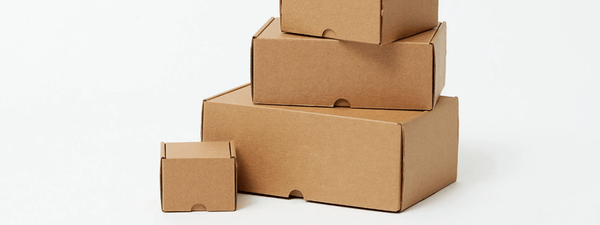
Find the closest box for each common order. With hundreds of postage boxes and mailer boxes to choose from, there's often a stock size within a few millimetres.
4. Use adjustable boxes for varying heights
Multi-crease boxes have extra fold lines, so one box can be set to several heights. They suit ranges where products share a footprint but vary in depth.
5. Test, then standardise
Test the new sizes with real orders, then write down which box each order uses so every packer chooses the same one.
What it means for you
The same question, answered for where your business is today.
Choose your stage at the top of the page to open the advice for you.
Start-up · under 100 units
Choose two or three box sizes that fit your best sellers closely, rather than one big box for everything.
Check the cubic weight of each size with your carrier's calculator before you buy in quantity.
Growing · 100 to 2,499 units
Review your box sizes every few months against what you're actually sending. A size that fitted last year's range may not fit this year's.
Try this: for your three most common orders, compare postage, filler and packing time in your current box and the next size down.
Enterprise · 2,500 units and more
Right-sizing is one of the biggest freight levers at volume. Design cartons around your products and your pallet, and track the saving per shipment.
Changing board thickness changes the outside size. Re-check cubic weight and cartons per pallet before switching.
Common mistakes
- 1One box for everything. It's simple, but most orders end up in a box that's too big. A few sizes usually save more than they cost.
- 2Right-sizing without testing. A box that's too tight can damage products or split. Test before you commit.
- 3Ignoring the outside size. Carriers measure the outside. Choose sizes on internal dimensions, then check the external size.
- 4Forgetting multi-item orders. Make sure your range also covers your most common multi-item orders.
Right-sizing questions
What is right-sized packaging?
How does right-sizing save money?
How many box sizes do I need?
What if my products vary in height?
Can you help me choose sizes?
From our customers
The Nonsense MakerA wide range of box sizes lets them pack everything from greeting cards to homewares without wasting materials.
Read their story →Keep reading
Find a better fit

Want to bring your freight costs down?
Send us your most common orders and the boxes you use now. Our Melbourne packaging team will suggest better-fitting sizes, usually within 1 business day.