


Guide / Packaging basics / Chapter 1.2
How to measure your product for packaging.
The right box starts with the right measurements. Here's how to measure any product, in the right order, so the box you order fits the first time.
The short answer
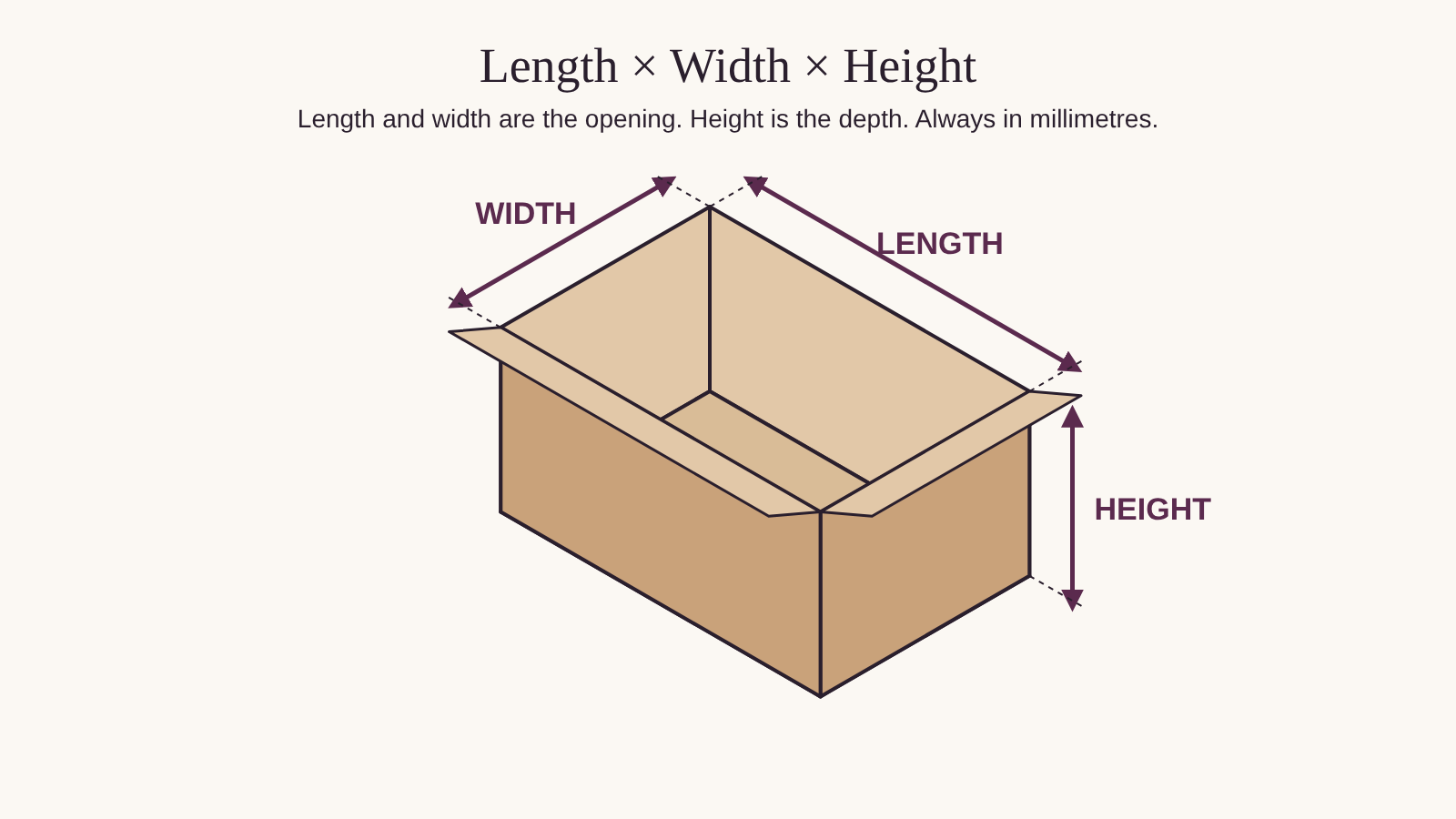
Measure your product at its widest points, in millimetres, in the order length × width × height. Length is the longest side of the opening, width is the shorter side of the opening, and height is the depth. Measure the product as it will be packed, including any wrapping, inserts or product box, then add a small allowance for clearance and cushioning. Our box sizes are internal, so you don't need to add the board thickness. Give those numbers to us or use our box size finder.
What you'll need
- A rigid ruler or tape measure in millimetres. A metal tape is more accurate than a sewing tape.
- Two flat objects, such as books, to mark the widest points of irregular items.
- The product exactly as it will ship: with its bottle, lid, pump, swing tag, product box or bubble wrap.
- A pen and paper, or your phone's notes app, to record each measurement as you go.
Step by step
1. Pack the product as it will ship
Put on everything that will go in the box: the lid, the pump, the product box, the bubble wrap, the tissue. A candle in a jar is a different size to a candle in a jar with a cardboard sleeve. Measure what will actually go into the box.
2. Measure length, width and height at the widest points
Lay the product down the way it will sit in the box. Measure the longest side as the length, the shorter side as the width and the depth from the base to the top as the height. Always measure to the widest point, such as a lid, handle or label that sticks out.
3. Use flat objects for irregular shapes
For bottles, round tins or oddly shaped items, stand a book against each side and measure the gap between them. This gives you the true outer size, not the size of the middle.
4. Round up, never down
Round each measurement up to the nearest whole millimetre. Write it down in the order length × width × height, for example 220 × 150 × 80 mm.
5. Add clearance
If you measured the product already wrapped, don't add the wrapping again. Add only the extra room you need for filler or cushioning, plus a few millimetres so it slides in, on each side. Our clearance chapter explains how much to allow. If you're unsure, give us the product size and we'll work out the box.
6. Weigh it
Weigh the packed product too. Weight decides how strong the box needs to be and what postage will cost.
Length, width and height: which is which?
This is how PackQueen lists box sizes: internal dimensions in millimetres, in the order length × width × height. Other suppliers may list sizes differently, so check before you compare.
| Measurement | What it means | Tip |
|---|---|---|
| Length | The longest side of the opening | Measure across the top of the box, the long way |
| Width | The shorter side of the opening | Measure across the top, the short way |
| Height | The depth, from the base to the opening | On a mailer box, this is the side wall |
What it means for you
The same question, answered for where your business is today.
Choose your stage at the top of the page to open the advice for you.
Start-up · under 100 units
Measure your two or three best-selling products and find a stock box that fits each. You may find one box fits several products with a little filler.
Order a sample of the size you think is right and test it with the real product before you buy more.
Growing · 100 to 2,499 units
Measure every product in your range and record the sizes in one list. You'll quickly see which products could share a box, which saves on stock and storage.
Try this: group products that are within 10–20 mm of each other. One well-chosen size can often replace two or three.
Enterprise · 2,500 units and more
Record dimensions and weights for every product in your specification, measured the same way each time. Small differences multiply across thousands of shipments.
If you're changing product packaging, re-measure before reordering boxes, not after.
Common mistakes
- 1Measuring the product, not the packed product. Forgetting the lid, pump, product box or wrap is the most common reason a box doesn't fit.
- 2Mixing up box and product measurements. Our sizes are internal, so the board is already allowed for. But a box exactly the same size as your product leaves no room for cushioning, clearance or small size differences between products.
- 3Measuring in centimetres. Half a centimetre is 5 mm, which is the difference between a snug fit and a box that won't close. Use millimetres.
- 4Getting the order wrong. Height is the depth. Swapping width and height gives you a box with the opening on the wrong side.
- 5Measuring the middle of a curved product. Always measure the widest point, including handles, lids and labels.
Measuring questions
In what order are box dimensions written?
Should I measure in centimetres or millimetres?
How do I measure a round product like a bottle or tin?
How much bigger than my product should the box be?
Can you work out the box size for me?

From our customers
David Deans SkincareAfter testing many boxes, they found A5 postage boxes that fit their products perfectly and fit inside a 1 kg Express Post satchel.
Read their story →Keep reading
Find your box
Have your measurements?
Use our box size finder to search by size, or send us your product's measurements and our Melbourne team will recommend the right box.