


Guide / Packaging basics / Chapter 1.3
Internal vs external box dimensions.
A box has two sets of measurements: the space inside and the space it takes up outside. Knowing which is which stops you ordering boxes that don't fit your product or don't fit the courier's limits.
The short answer
Internal dimensions are the usable space inside the box, and they're what you match to your product. External dimensions are the overall size of the box, and they're what couriers, shelves and pallets care about. The difference is the thickness of the board, plus a little extra where flaps overlap. Our box listings show internal dimensions in millimetres, in the order length × width × height.
Why the two sizes are different
Cardboard has thickness. Every wall, base and lid adds to the outside of the box, so a box is always bigger on the outside than on the inside.
How much bigger depends on the board and the box style. Thin E flute board, about 1.5 mm, adds very little. BC double wall board, about 7 mm, adds noticeably more, especially on boxes where flaps fold over each other. Our flute chapter explains board thickness in more detail.
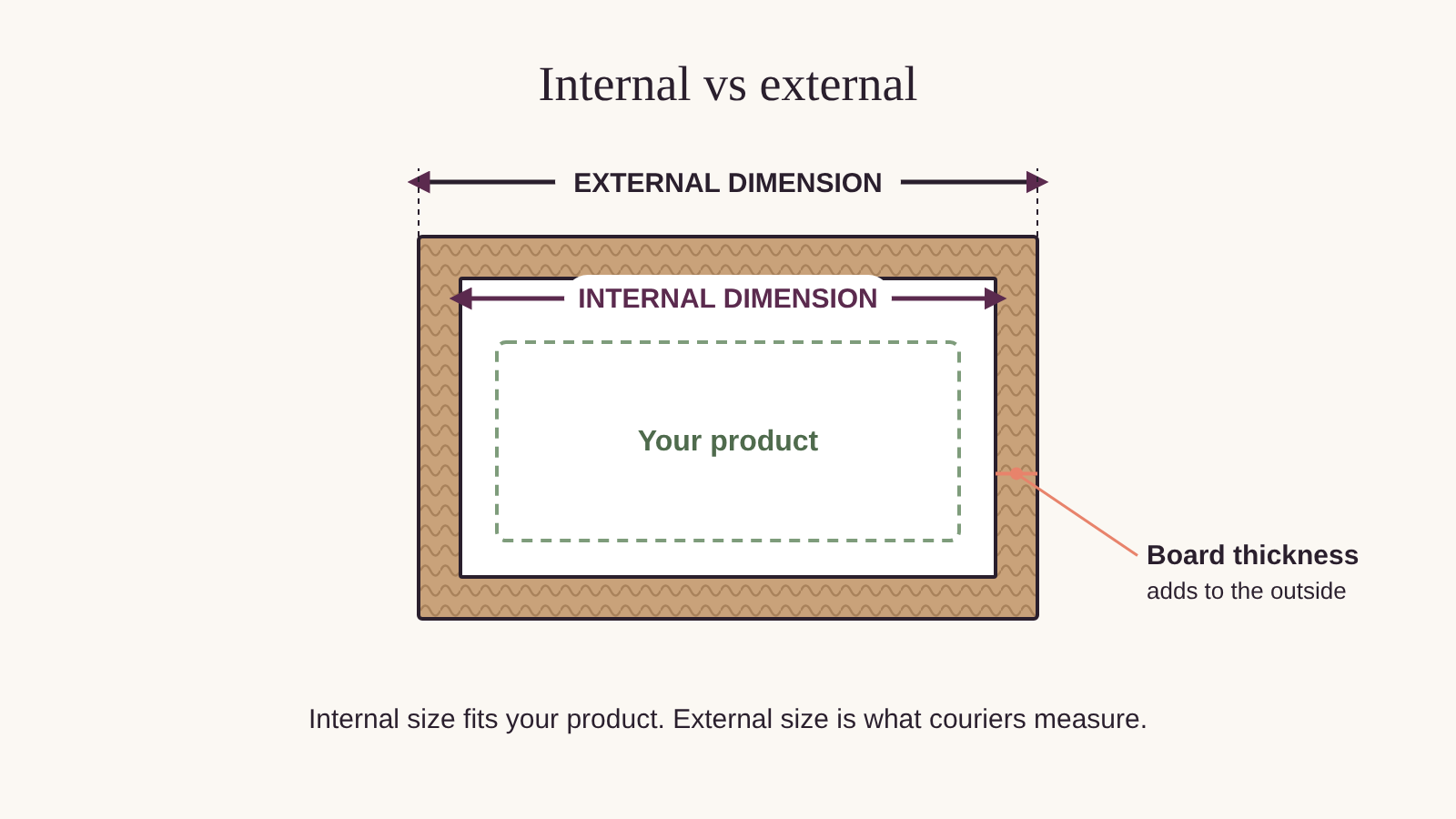
How much board adds to each side
Which measurement to use when
Use internal dimensions to fit your product
Match the internal size to your packed product plus clearance. If your product measures 200 × 140 × 60 mm and you want a few millimetres around it, look for a box with internal dimensions a little larger than that.
Use external dimensions for postage, storage and freight
Couriers and Australia Post measure the outside of your parcel. Postage size limits, cubic weight, shelf space and how many boxes fit on a pallet all depend on external dimensions. If you're close to a courier limit, ask us for the exact external size of the box rather than estimating it from the board thickness.
Check which one a size refers to
When you compare boxes from different places, check whether the size is internal or external. Two boxes described with the same numbers can be a few millimetres apart once you allow for the board.
Internal vs external at a glance
| Internal dimensions | External dimensions | |
|---|---|---|
| What it measures | The usable space inside the box | The overall size of the box |
| Use it for | Fitting your product | Postage limits, cubic weight, storage, pallets |
| Affected by board thickness? | No, it's the space you get | Yes, thicker board makes it bigger |
| How we list it | On our box listings, length × width × height in mm | Ask us if you need it for a specific box |
What it means for you
The same question, answered for where your business is today.
Choose your stage at the top of the page to open the advice for you.
Start-up · under 100 units
Choose boxes by internal size to fit your product, then check the outside size fits the postage option you plan to use.
If you're right on a postage size limit, a box in thinner board can sometimes keep you under it.
Growing · 100 to 2,499 units
When you move to custom sizes, give us your product size and we'll work out the box. That way the board thickness is accounted for.
Try this: for your most common box, record both the internal and external size in your packing notes.
Enterprise · 2,500 units and more
Put both internal and external dimensions in your packaging specification, along with the board. Your warehouse, freight and pallet plans all depend on the outside size.
Changing board grade changes the external size. Re-check pallet patterns and freight before switching.
Common mistakes
- 1Ordering a box the same size as the product. If the internal size matches your product exactly, there's no room for wrapping, and the product may not go in at all.
- 2Using internal sizes for postage. Couriers measure the outside. A box that's under a size limit on the inside may be over it on the outside.
- 3Comparing sizes without checking. One listing may show internal dimensions and another external. Check before you compare prices.
- 4Forgetting board when switching. Moving from E flute to B flute or double wall makes the box bigger on the outside, even if the inside stays the same.
Box dimension questions
Are your box sizes internal or external?
How much bigger is the outside of a box?
Which size do couriers use?
Which size should I give you for a custom box?
Why doesn't my product fit a box with the same measurements?
Keep reading
Shop by size

Need the exact size of a box?
Tell us which box you're looking at, or send us your product's size, and our Melbourne team will confirm the fit, usually within 1 business day.