


Guide / Artwork & design / Chapter 5.8
What information must go on packaging?
Some products need specific information on the pack. Here's an overview of the main Australian labelling rules, where to find the official guidance, and how to leave room for it in your design.
The short answer
What must appear on your packaging depends on what you sell. Pre-packaged goods generally need measurement information, such as weight or volume, shown in a set way. Many food products need a country of origin label and food information under the Food Standards Code. Any claim you make, such as "made in Australia", must be accurate and truthful. This chapter is general information, not legal advice. Check the official sources below for your product.
The main rules to know about
Measurement on pre-packaged goods
Australia's trade measurement laws cover pre-packaged goods. According to the Australian Government's business.gov.au, pre-packaged goods must show measurement details, such as weight or volume, in a prescribed position, size and format, and goods packed in Australia must also show the packer's name and address. The National Measurement Institute's guide to selling pre-packaged goods explains the detail.
Food labelling
Food labels are covered by the Food Standards Code. Depending on the food, labels may need use-by or best-before dates, ingredients, allergens, nutrition information and the supplier's name and address. Food Standards Australia New Zealand (FSANZ) publishes the labelling rules.
Country of origin claims
Under the Australian Consumer Law, country of origin claims must be accurate and truthful, and most retail food needs a country of origin label. The ACCC explains the rules in its guide to country of origin claims.
Other product rules
Some products have their own labelling standards, such as cosmetics ingredients, chemicals, therapeutic goods and products with safety warnings. The business.gov.au labelling guide is a good starting point for finding which apply to you.
Where to check
Official sources, checked October 2026. Rules change, so always check the current guidance.
| Topic | Who to check with |
|---|---|
| Weight, volume and packer details | National Measurement Institute |
| Food labels | Food Standards Australia New Zealand (FSANZ) |
| Country of origin and misleading claims | ACCC |
| Cosmetics ingredients labelling | ACCC Product Safety Australia |
| Finding which rules apply | business.gov.au |
Designing with labelling in mind
Required information takes space, and some of it must appear in a particular place or size. Plan for it before you design, not after.
- Work out what your product must show, then reserve space on your dieline in the required panel or location.
- Keep required text inside the safe zone, away from folds, and large enough to read.
- Barcodes and batch codes are often a retailer or commercial requirement rather than a legal one, so check what your stockists ask for.
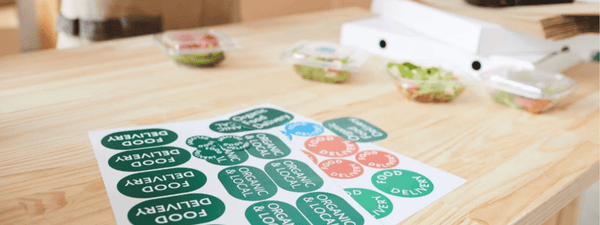
- If information changes often, such as batch codes or dates, a printed label or sticker can be easier than printing it on the box. Our custom labels start from 1 roll.
- Check any claims on your packaging, including environmental claims, are accurate and can be backed up.
What it means for you
The same question, answered for where your business is today.
Choose your stage at the top of the page to open the advice for you.
Start-up · under 100 units
Before you design anything, find out which rules apply to your product using the official sources above. A label on stock packaging is often the simplest way to show required information.
If you sell food, start with the FSANZ labelling pages.
Growing · 100 to 2,499 units
As you move to printed packaging, reserve space for required information on every design, and keep it consistent across your range.
Try this: create one information panel layout and reuse it for every product.
Enterprise · 2,500 units and more
Make labelling part of your packaging specification and approval process, with someone responsible for checking required information before every proof is approved.
Review your labels whenever the rules or your products change.
Common mistakes
- 1Designing first, adding information later. Required text squeezed in at the end can end up too small or in the wrong place.
- 2Origin claims that can't be backed up. Claims like "made in Australia" must be accurate and truthful.
- 3Printing information that changes. Dates and batch codes are often easier on a label than on the box.
- 4Assuming the rules are the same for every product. Food, cosmetics and other goods have different requirements. Check yours.
Packaging labelling questions
What has to be on product packaging in Australia?
Who sets food labelling rules?
Where can I find the rules for weight and volume on packs?
Can PackQueen tell me what my label must say?
Can I print required information on a label instead of the box?
Keep reading
Labels and packaging
Need to fit information on your packaging?
Tell us what you sell and what your packaging needs to show. Our team will help you plan the space and the best way to print it.