


Guide / Materials & board grades / Chapter 3.10
Packaging around food: outer vs direct contact.
Food businesses need to think about which packaging actually touches the food. Here's the difference between outer and direct-contact packaging, what to ask, and where to find the official rules.
The short answer
Direct-contact packaging touches the food itself, like a cake board, a takeaway tray, a wrap or a pouch. Outer packaging holds food that's already wrapped or packed, like a gift box holding wrapped chocolates or a carton of sealed jars. In Australia, food businesses must use packaging that is fit for its intended use and unlikely to contaminate food. Check each product's details for its intended use, and see Food Standards Australia New Zealand for the official guidance.
Outer packaging vs direct contact
Outer packaging
This packaging never touches unwrapped food. A box holding bottled sauces, a carton of packaged biscuits or a gift box of wrapped chocolates are all outer packaging. Standard boxes, bags and cartons are often used here, along with labels, ribbon and tissue for presentation.
Direct-contact packaging
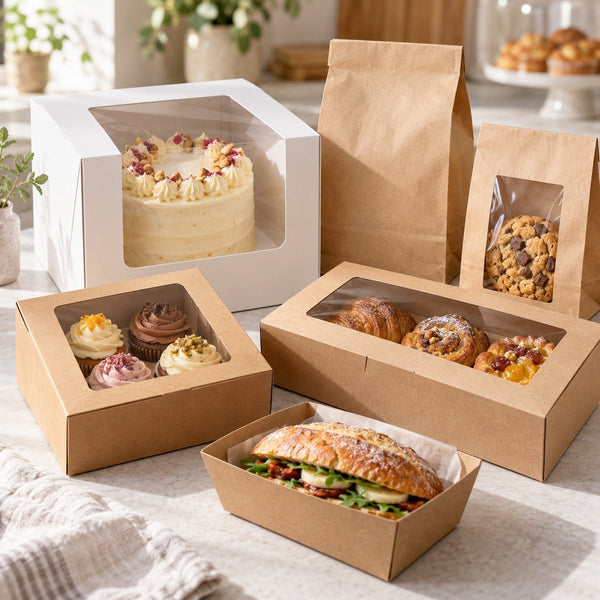
This packaging touches the food. Cake boards, bakery boxes holding unwrapped cakes, takeaway containers, trays, cups and wraps all fall into this group. Here, the material and its intended use matter, because the packaging is part of keeping the food safe.
The grey areas
Some packaging sits in between. A cookie box might hold cookies directly, or cookies in sealed bags. A window box might let food touch the window film. Decide how your food will actually be packed, and choose packaging intended for that use.
If you use a liner or wrap, it must itself suit the food, the temperature, any grease or moisture and how long the food stays in contact. A liner doesn't automatically make an unsuitable outer box suitable, so check both.
What the rules say
Food Standards Australia New Zealand (FSANZ) explains that manufacturers are required by the Food Standards Code to ensure food in contact with packaging is safe. In Australia, food businesses must also meet Standard 3.2.2, which requires packaging material that is fit for its intended use and not likely to cause food contamination.
This chapter is general information, not legal or food safety advice. Your local council's environmental health officer and FSANZ are the best sources for what applies to your business.
Questions to ask about food packaging
Use these when choosing packaging for food products.
| Question | Why it matters |
|---|---|
| Will the packaging touch unwrapped food? | Decides whether you need packaging intended for direct food contact |
| Is the food fatty, oily, wet or hot? | Some materials suit dry food only; grease and moisture need suitable materials or linings |
| Will it be stored chilled, frozen or heated? | Temperature affects how packaging performs |
| Is the product described for this use? | Check the product details for its intended use |
| Does the printed side touch the food? | Inks and coatings are usually meant for the outside of the pack |
What it means for you
The same question, answered for where your business is today.
Choose your stage at the top of the page to open the advice for you.
Start-up · under 100 units
Work out which items touch your food and which don't. For outer packaging, you have a wide choice. For direct contact, choose products described for that use, and check with your council if unsure.
A wrap or liner between food and a decorative box is a common, practical approach.
Growing · 100 to 2,499 units
As your range grows, list every packaging item and whether it touches food. Keep product details and any supplier documents for direct-contact items on file.
Try this: review your packaging list whenever you add a new product or change a recipe, such as adding oil or moisture.
Enterprise · 2,500 units and more
Include food-contact requirements in your packaging specification and ask suppliers for the documentation your food safety program needs before ordering.
Record which packaging is approved for which products, so substitutions don't happen in busy periods.
Common mistakes
- 1Assuming all boxes suit direct food contact. Many boxes are designed as outer packaging. Check the product details for intended use.
- 2Letting the printed side touch food. Printing is designed for the outside. Keep food on the inside surface or use a liner.
- 3Ignoring grease and moisture. Oily or wet foods can soak into unsuitable board. Use a suitable liner, tray or container.
- 4Relying on a product name alone. A name isn't a specification. Check the product details and ask if you need more information.
Food packaging questions
What's the difference between outer and direct-contact packaging?
Who regulates food packaging in Australia?
Can I put cakes and cookies straight into a box?
Can I put food in a printed box?
Where can I get advice for my business?
Keep reading
Shop food packaging

Packing food products?
Tell us what you make and how it's packed. Our Melbourne team will help you find packaging suited to it, usually within 1 business day.