


Guide / Packaging basics / Chapter 1.7
Packaging glossary: A–Z of packaging terms.
Flutes, dielines, bleed, MOQ and more. Plain-English definitions of the packaging terms you'll hear when ordering boxes, bags and printed packaging.
The short answer
Packaging has its own language, but most terms are simple once explained. This glossary covers the words you're most likely to meet when choosing, quoting and printing packaging, from bleed and board to flute, GSM, MOQ and RSC. Use your browser's find function to jump to a term, or browse by letter.
Terms A to F
| Term | Meaning |
|---|---|
| Artwork | The final design files used to print your packaging, including logos, text and images. |
| BC flute | Double wall corrugated board combining one B flute and one C flute. Used for heavy and stacked loads. |
| Backing board | A flat sheet of board placed behind prints, cards or flat items to stop them bending. |
| Bleed | Extra artwork that runs past the trim line so there's no white edge after cutting. Our full-coverage templates use 10 mm. Always use the template for your exact product. |
| Board | General word for the material a box is made from, such as corrugated board or paperboard. |
| Box compression | A test of how much weight a complete box can carry on top before collapsing. |
| Bubble mailer | A mailing bag lined with bubble cushioning. |
| Burst strength | A test of how much pressure a board's surface can take before it ruptures. |
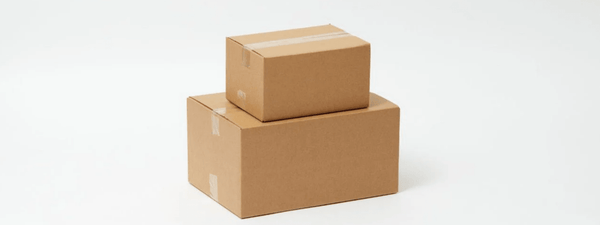
| Carton | A box, usually a corrugated shipping box or a paperboard product box. |
| CMYK | The four ink colours (cyan, magenta, yellow, black) used to print full-colour images. |
| Corrugated board | Board made of flat liners with a wavy flute between them. See our flute chapter. |
| Cubic weight | A weight calculated from a parcel's size, used by carriers. See our cubic weight chapter. |
| Debossing | Pressing a design into the surface of board or paper so it sits below the surface. |
| Die-cut | Cut to shape with a steel cutting die, used for mailer boxes and custom shapes. |
| Dieline | The flat outline of a box showing cut lines, fold lines and print areas, used to set up artwork. |
| Digital printing | Printing direct from a digital file without plates, suited to short runs. Ours starts from 25 units. |
| Double wall | Board with two layers of flute between three liners. |
| E flute | A thin corrugated flute, about 1.5 mm, popular for mailer and product boxes. |
| Edge crush test (ECT) | A test of how much force a board can take on its edge before buckling. |
| Embossing | Raising a design above the surface of board or paper. |
| External dimensions | The overall outside size of a box. See our dimensions chapter. |
| Flexo printing | A printing method using flexible plates, common on shipping cartons. Ours starts from 250 units. |
| Flute | The wavy layer inside corrugated board that gives it strength and cushioning. |
| Fold clearance | The gap to keep between artwork and a fold edge. Our digitally printed boxes need 20 mm clearance from fold edges. |
| Foil stamping | Applying metallic or coloured foil with heat and pressure. Our foils: black, white, gold, silver and rose gold. |
| FSC | Forest Stewardship Council, a certification system for responsibly sourced forest products. |
Terms G to O
| Term | Meaning |
|---|---|
| Gloss lamination | A shiny protective film over printed board or paper. |
| GSM | Grams per square metre, the weight of paper or paperboard. Our paperboard boxes use 285gsm board. |
| Honeycomb paper | Paper cut and expanded into a honeycomb pattern, used as cushioning. |
| Insert | A card, tray or foam piece inside a box that holds the product in place. |
| Internal dimensions | The usable space inside a box. Our box listings show internal dimensions. |
| Kraft | Board or paper in the natural brown colour of unbleached fibre. |
| Lamination | A thin film bonded over printed board or paper to protect and finish it. |
| Lead time | How long it takes to make and dispatch an order, usually counted from artwork approval for custom work. |
| Liner | The flat paper layer on each side of the flute in corrugated board. |
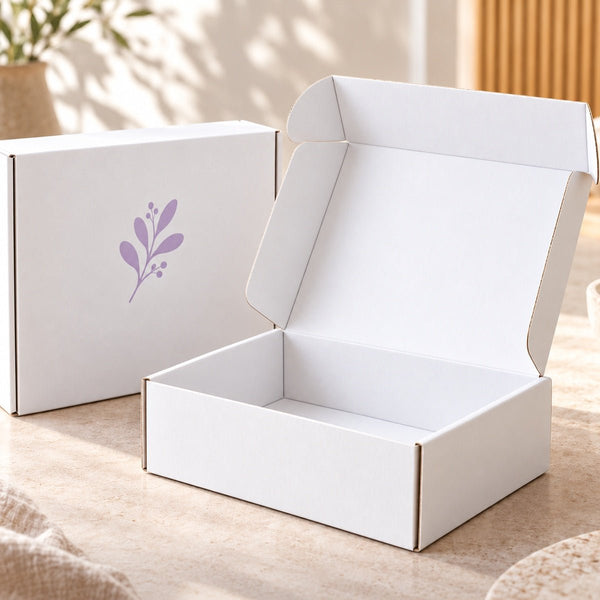
| Mailer box | A die-cut box with a hinged lid that's strong enough to post. See our mailer box chapter. |
| Matt lamination | A low-shine protective film over printed board or paper. |
| MOQ | Minimum order quantity, the smallest number you can order for a product or print run. |
| Multi-crease box | A box with extra fold lines so it can be set to several heights. |
| Offset printing | A high-quality printing method suited to paperboard and longer runs. Ours starts from 250 units. |
Terms P to Z
| Term | Meaning |
|---|---|
| Pantone | A standard colour matching system used to specify exact colours. We match Pantone colours for screen printing. |
| Paperboard | A thick, single-layer board without flutes, used for folding cartons and product boxes. |
| Primary packaging | The packaging in direct contact with the product, such as a bottle or jar. See our packaging layers chapter. |
| Proof | A preview of your printed packaging to check before production. We send digital proofs, typically within 1 business day. |
| Rigid box | A box made from thick board wrapped in paper that keeps its shape. Traditional rigid boxes don't fold flat; collapsible rigid boxes are made to ship flat. |
| RSC | Regular slotted carton, the classic shipping box. See our shipping cartons chapter. |
| Safe zone | The area inside the trim line where important text and logos should sit. Our full-coverage templates use 10 mm; digital boxes need 20 mm from fold edges. |
| Satchel | A lightweight mailing bag, usually plastic, for soft goods. See our satchels chapter. |
| Screen printing | A printing method that pushes ink through a mesh screen, good for bold colours and white ink. |
| Secondary packaging | Packaging around the primary pack that presents, protects or groups it, such as a product carton, gift box or mailer box. |
| Shipping packaging | Packaging that protects goods in transit, also called tertiary or transit packaging. |
| Single wall | Corrugated board with one flute between two liners. |
| Spot UV | A glossy coating applied to selected areas of a print, often a logo. |
| Stock packaging | Ready-made packaging in standard sizes. See our stock vs custom chapter. |
| Tissue paper | Thin paper used to wrap products and create an unboxing. |
| Trim line | Where printed packaging is cut to its final shape. |
| Tuck end box | A paperboard box with flaps that tuck in at each end. |
| Void fill | Material that fills empty space in a box to stop products moving. |
| White ink | Ink that prints white on dark or kraft board. We can screen print white ink. |
What it means for you
The same question, answered for where your business is today.
Choose your stage at the top of the page to open the advice for you.
Start-up · under 100 units
You don't need to learn every term. Knowing internal dimensions, MOQ, lead time and proof will help with most first orders.
When a term in a quote isn't clear, ask. We're happy to explain.
Growing · 100 to 2,499 units
Bleed, safe zone, dieline and print method become important once you order printed packaging. Learn them before your first custom run.
Try this: keep a one-page note of your packaging terms and sizes for your team.
Enterprise · 2,500 units and more
Use consistent terms in your packaging specification so suppliers, designers and your warehouse all mean the same thing.
Define tolerances and test terms in writing if your business relies on them.
Glossary questions
What does MOQ mean in packaging?
What is a dieline?
What does GSM mean?
What is bleed?
What is a flute in cardboard?
Keep reading
Popular packaging

Still not sure what something means?
Ask our Melbourne packaging team. We'll explain it in plain English and help you choose, usually within 1 business day.