


Guide / Shipping & protection / Chapter 7.7
Palletising and freight.
When you ship cartons by the pallet, the way they're stacked, wrapped and protected matters as much as the cartons themselves. Here's how to build a pallet load that arrives stable and undamaged.
The short answer
Build a stable pallet by stacking heavy cartons at the bottom, keeping the load within the edges of the pallet, using a column or interlocking pattern that suits your cartons, adding edge protectors on the vertical corners, and wrapping the load firmly with stretch film from the pallet base to the top. Check your freight company's height, weight and labelling requirements before you build the load. This is general advice for preparing your own freight.
Before you stack
- Check the pallet for broken boards or protruding nails, and use the pallet size your freight company accepts.
- Check your freight company's rules for maximum height, weight and overhang, and how labels must be placed.
- Use cartons that suit the load. Cartons at the bottom of a pallet carry the weight of every layer above them. Our shipping cartons chapter explains board choices.
Stacking patterns
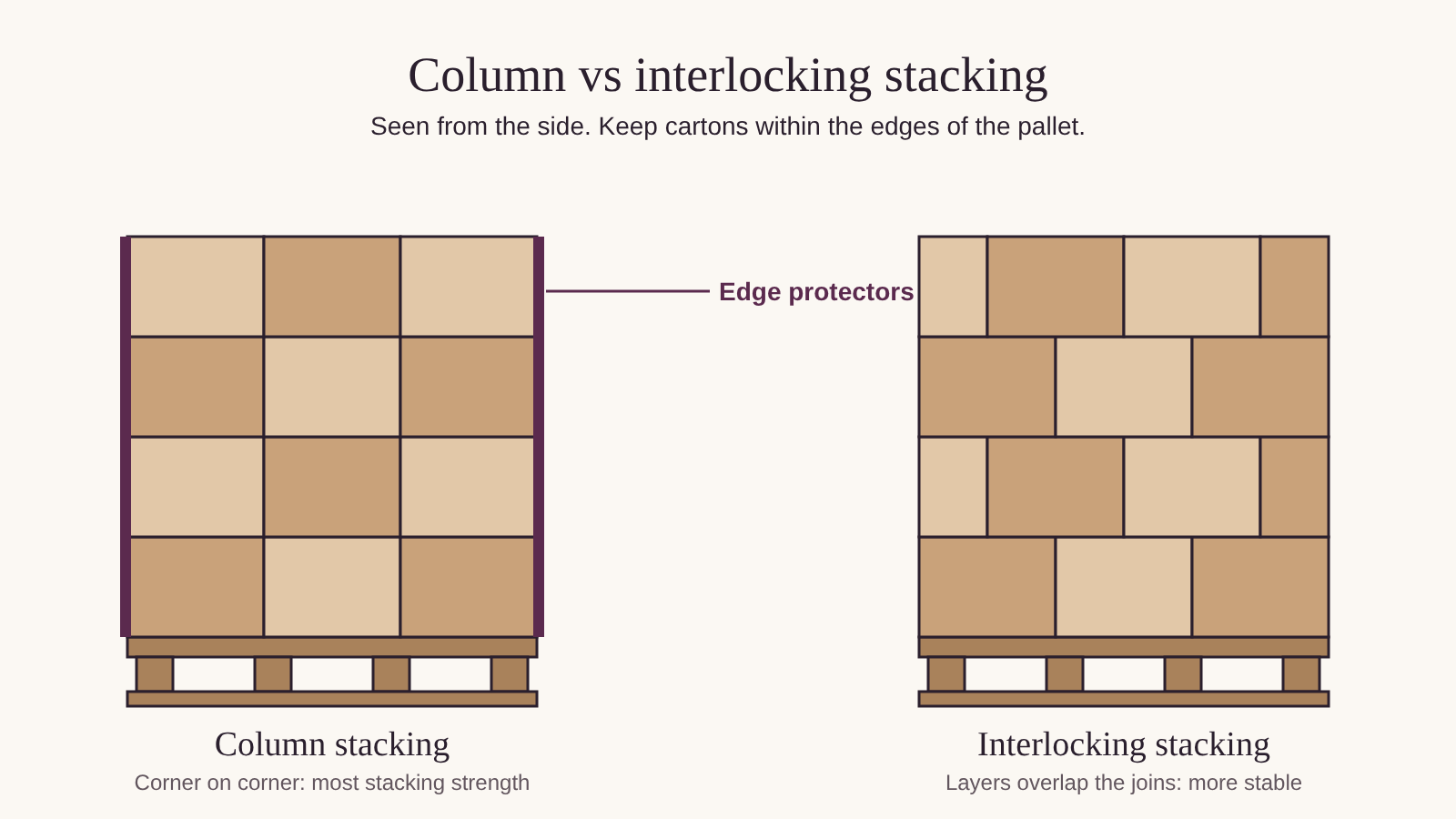
Column stacking
Each carton sits directly on top of the one below, corner on corner. Because a carton's strength is mostly in its corners and walls, column stacking makes the most of its stacking strength. It's less stable on its own, so it relies on good wrapping and edge protection.
Interlocking stacking
Each layer is turned or shifted, like bricks in a wall, so cartons overlap the joins below. This ties the load together and makes it more stable, but cartons don't sit corner on corner, so they carry weight less efficiently.
Which to use
Column stacking suits heavy, uniform cartons where crushing is the main risk. Interlocking suits lighter cartons where stability is the main risk. Many loads use column stacking with a final interlocked layer, wrapped firmly.
Building a stable load
General guide only. Always follow your freight company's requirements.
| Step | What to do | Why |
|---|---|---|
| 1. Heavy at the bottom | Put the heaviest cartons on the lowest layers | Keeps the load stable and stops crushing |
| 2. Keep within the edges | No cartons hanging over the pallet edge | Overhanging cartons lose support and crush |
| 3. Flat, level layers | Fill gaps so each layer is level | Uneven layers create weak points |
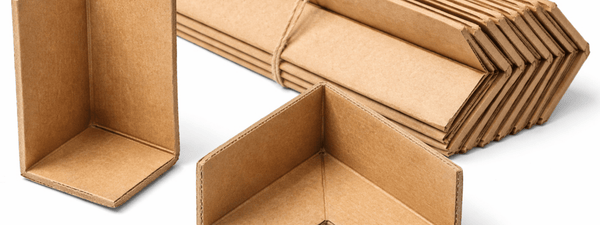
| 4. Edge protectors | Add edge protectors on each vertical corner | Spreads strap and wrap pressure, protects carton edges |
| 5. Wrap from the base | Start stretch film around the pallet base, then wrap upwards with overlap | Ties the load to the pallet so it can't slide |
| 6. Label clearly | Labels on the sides, as your freight company requires | Helps handling and delivery |
Wrapping and securing
Hand stretch film holds cartons together and to the pallet. Start by wrapping the base of the pallet a few times, then work upwards with each layer of film overlapping the last, and finish with extra wraps at the top. Cardboard edge protectors on the vertical corners help the film hold the load firmly without crushing carton edges. For heavier or rigid loads, strapping adds extra security. A few wraps don't automatically make a load secure: the film type, wrap tension and strapping need to suit the load's weight and your freight company's requirements, and the bottom cartons must be strong enough to carry the stack.
What it means for you
The same question, answered for where your business is today.
Choose your stage at the top of the page to open the advice for you.
Start-up · under 100 units
Most start-ups don't ship pallets. If you need to send a large one-off order, ask your freight company how they want it presented.
Use strong cartons and tape them well. They'll be at the bottom of someone else's stack.
Growing · 100 to 2,499 units
If you're starting to send pallets to retailers or a warehouse, write down a standard stacking pattern and wrapping method for each product.
Try this: photograph a well-built pallet and use it as the standard.
Enterprise · 2,500 units and more
Design cartons around your pallet: carton size, cartons per layer and layers per pallet all affect freight cost and damage. Specify the stacking pattern and wrap in your packaging specification.
Changing board thickness changes the outside size of cartons, which can change how many fit per layer.
Common mistakes
- 1Overhanging the pallet. Cartons over the edge lose support and are easily crushed or caught.
- 2Light cartons at the bottom. The bottom layer carries the whole load. Put heavy, strong cartons there.
- 3Not wrapping the base. If the film doesn't grip the pallet, the whole load can slide off it.
- 4Pyramid tops. Uneven top layers get crushed or shift. Keep layers flat and level.
Palletising questions
How should I stack cartons on a pallet?
What's the difference between column and interlocking stacking?
Do I need edge protectors?
How do I wrap a pallet with stretch film?
How high can I stack a pallet?
Keep reading
Shop for pallet loads


Planning freight shipments?
Tell us your products, carton sizes and how you ship. Our Melbourne packaging team will suggest cartons and protection that suit, usually within 1 business day.