


Guide / Shipping & protection / Chapter 7.4
Courier vs Australia Post packaging.
Australia Post and courier companies price and handle parcels differently, and that changes which packaging makes sense. Here's what to check so your packaging fits the service you use.
The short answer
With Australia Post, you can use its prepaid satchels and flat rate packaging, where postage is based on size rather than weight for items 5 kg and under, or your own packaging, where postage is based on the greater of actual weight or cubic weight. Its general domestic parcel limits are 22 kg, 105 cm in length and 0.25 cubic metres. Courier companies set their own size and weight limits, conversion factors and packaging rules, so check your courier's terms. Whichever you use, a snug, well-sealed box is the best starting point.
How Australia Post charges
Australia Post explains on its size and weight guidelines page that postage for its prepaid satchels and mailing boxes, and for its flat rate packaging, is based on size, not weight, for items 5 kg and under.
When you use your own packaging, Australia Post says it assesses charges on the actual weight or the cubic weight equivalent, whichever is greater. It uses a conversion factor of 250 kg per cubic metre, and says that for non-contract parcels, such as those sent through MyPost Business, cubic charging generally isn't applied under 1 kg actual weight, although it reserves the right to apply it. Our cubic weight chapter explains the calculation.
Rules and prices change, so always check the current details with Australia Post and your own account terms.
How courier companies differ
Courier companies set their own rules, which can differ by service and by account. Before you choose packaging, check:
- Size and weight limits for each service, including the maximum length.
- The cubic conversion factor used to calculate cubic weight, which may differ from Australia Post's.
- Packaging requirements, such as whether satchels, tubes or irregular shapes attract extra charges.
- Labelling requirements, including where the label must go and whether old labels must be removed.
What to check for each option
General guide only. Always confirm with your carrier.
| Packaging | With Australia Post | With a courier |
|---|---|---|
| Prepaid satchels and flat rate packaging | Postage based on size, 5 kg and under | Not applicable |
| Your own box | Greater of actual or cubic weight | Usually the greater of actual or cubic weight, using the courier's factor |
| Your own satchel | Measured at its maximum points | Check the courier's rules for satchels |
| Large or long items | General limit 105 cm and 0.25 m³ | Check the courier's limits for each service |
Packaging that works with both
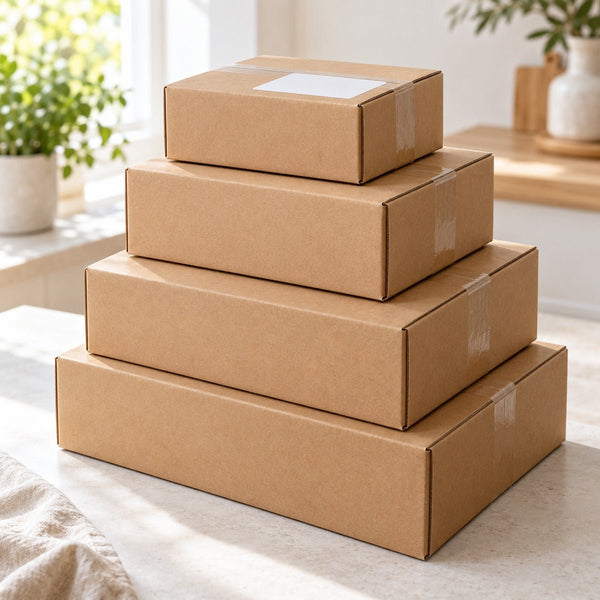
- Boxes sized for postal satchels. We sell boxes sized to fit inside Australia Post prepaid satchels, which add box protection to satchel pricing for items 5 kg and under. A third-party satchel of a similar size doesn't get Australia Post's prepaid pricing.
- Snug-fitting mailers and cartons. Less empty space keeps cubic weight down with any carrier.
- Strong sealing and clear labels. Australia Post's packing tips recommend heavy-duty packing tape and removing or covering old labels on reused boxes.
What it means for you
The same question, answered for where your business is today.
Choose your stage at the top of the page to open the advice for you.
Start-up · under 100 units
Most new businesses start with Australia Post. Compare its prepaid satchels with your own packaging for your most common orders, using its postage calculator.
If your product fits a box that fits inside a prepaid satchel, you get a box's protection with size-based pricing, for items 5 kg and under.
Growing · 100 to 2,499 units
As volumes grow, compare Australia Post and courier quotes for your most common parcel sizes and weights. The best packaging can differ for each.
Try this: list your three most common parcels and price each one both ways.
Enterprise · 2,500 units and more
Check your contract terms for cubic factors, size limits and surcharges, then right-size your packaging around them. Small changes repeat on every shipment.
Review packaging whenever you change carriers or contract terms.
Common mistakes
- 1Assuming every carrier charges the same way. Conversion factors, limits and surcharges vary. Check before you choose packaging.
- 2Measuring the inside of the box. Carriers measure the outside, at the widest points.
- 3Ignoring length limits. Long items such as posters, rolls and tubes can exceed a service's maximum length.
- 4Reusing boxes with old labels. Old labels and barcodes can confuse sorting. Remove or cover them.
Courier and Australia Post questions
What are Australia Post's parcel size limits?
Does Australia Post charge cubic weight?
Do couriers use the same cubic factor?
Can I put my own box inside a prepaid satchel?
Which is cheaper, a courier or Australia Post?
Keep reading
Packaging for posting

Want packaging that suits your carrier?
Tell us which carrier you use and your most common orders. Our Melbourne packaging team will suggest sizes that fit, usually within 1 business day.