By Monique, Founder of PackQueen · Packaging Strategy · 8 min read
3 Things You'll Take Away From This Article
➡ Plastic bags are a liability, not just a choice. Rising consumer expectations, incoming regulations and mounting environmental pressure mean plastic bags are becoming a business risk — not just an ethical one.
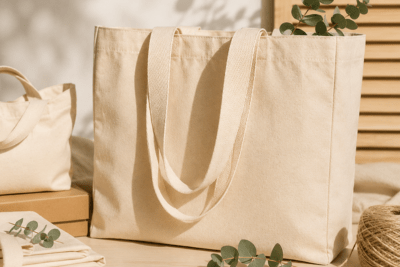
➡ Custom calico bags deliver measurable brand value. Unlike plastic, a branded calico bag keeps working for your business long after the sale — as a reusable marketing tool, a loyalty signal and a walking billboard.
➡ The switch costs less than most businesses expect. When you factor in reuse rates, brand visibility and customer perception, custom calico bags often deliver better ROI than disposable plastic alternatives.
The Problem With Plastic (And It's Not Just the Environment)
Hi, I'm Monique — founder of PackQueen. Let's talk about something most businesses know they need to address but keep putting off: the plastic bag.
Yes, the environmental argument is real and important. But today I want to make a broader business case — because the reasons to move away from plastic bags go well beyond sustainability.
Here's what plastic bags are costing Australian businesses right now:
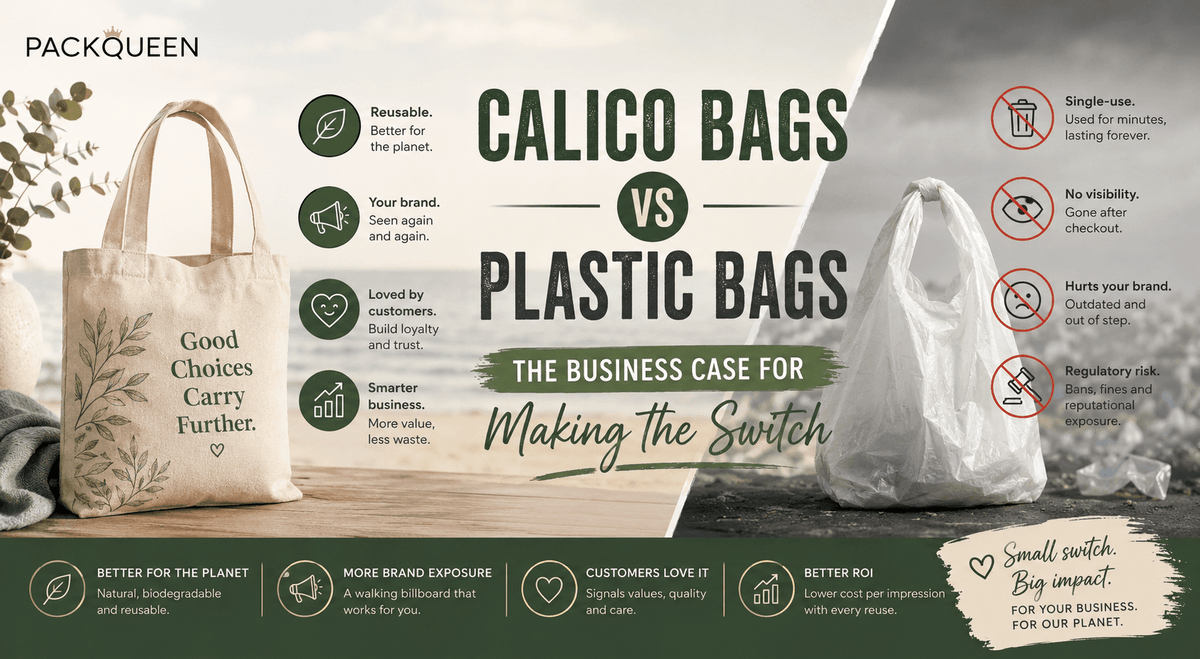
- Brand perception damage. Consumers increasingly associate plastic bags with businesses that don't care. In a competitive market, that perception is a competitive disadvantage.
- No residual value. A plastic bag is used once, disposed of, and forgotten. It does nothing for your brand after the point of sale.
- Regulatory risk. Plastic bag bans are expanding across Australian states and territories. Businesses that haven't transitioned face compliance costs and reputational exposure.
- Lost marketing opportunity. Every bag you hand out is a mobile billboard. With plastic, that billboard disappears within hours.
💡 The question isn't really 'should we switch from plastic?' — it's 'how much longer can we afford not to?'

Calico Bags vs Plastic Bags: The Full Comparison
Let's look at this side by side across the dimensions that matter most for Australian retail and ecommerce businesses:
| Factor | Plastic Bag | Custom Calico Bag |
|---|---|---|
| Environmental impact | Single-use, non-biodegradable | Reusable, natural cotton, biodegradable |
| Brand visibility | Single use — gone after checkout | Reused for months or years — ongoing exposure |
| Customer perception | Negative / neutral at best | Positive — signals values and quality |
| Cost per use | Low upfront, zero residual | Higher upfront, cost-per-impression drops with reuse |
| Regulatory compliance | Risk of bans and fines | Compliant across all Australian jurisdictions |
| Customisation | Limited — sticker or stamp only | Full print, multiple colours, your logo and message |
| Perceived product value | Diminishes — cheap association | Enhances — adds to unboxing or in-store experience |
| Gifting suitability | Poor | Excellent — doubles as gift wrap |
The Real Cost of a Plastic Bag (It's Not What You Think)
Most businesses compare the unit cost of a plastic bag to a calico bag and stop there. But that comparison misses most of the picture.
What you're actually paying for with plastic
- A one-time interaction that ends at the carpark
- No brand recall after the point of sale
- A material that ends up in landfill or waterways
- An increasingly negative brand signal to environmentally aware customers
What you get with custom calico bags
- Reuse rate. A quality calico bag gets used an average of 50–150 times. Each use is another brand impression — effectively reducing your cost per impression to cents.
- Social currency. Customers carry branded calico bags to markets, cafes and workplaces. Your brand travels with them.
- Gifting utility. Calico bags are routinely reused as gift bags — extending their life and your brand's reach even further.
- Loyalty signal. Receiving a well-made branded bag communicates that your business has invested in the experience.
📊 When you divide the cost of a custom calico bag by its average number of uses, the cost-per-impression is often lower than a plastic bag — with none of the environmental or brand liability.
What Makes a Great Custom Calico Bag?
Material weight and quality
- Lightweight (100–140gsm) — suitable for smaller products, gifting, boutique retail packaging
- Mid-weight (180–220gsm) — ideal for most retail and ecommerce packaging applications
- Heavy-weight (280gsm+) — for groceries, heavy products, premium gifting
Handle style
- Short handles — handheld carry, retail-style
- Long handles — shoulder carry, more versatile for everyday reuse
- Gusset base — adds structure and capacity, ideal for heavier or bulkier products
Print options
- One-colour screen print — cost-effective, classic, works well for bold logos
- Multi-colour print — more visual impact, better for illustrated or detailed designs
- Full-colour sublimation — photographic quality, premium finish
Real example → A Byron Bay homewares brand switched from plastic carry bags to heavyweight custom calico bags printed with their signature hand-drawn coastal illustration. Within six months, customers were posting photos of the bags at markets, beaches and in their homes — organic content that reached tens of thousands of people with zero ad spend.
When to Use Custom Calico Bags in Your Business
| Use Case | Bag Style | Print Recommendation | Key Benefit |
|---|---|---|---|
| In-store retail | Mid-weight, short handle | Bold 1-colour logo print | Walking brand billboard |
| Ecommerce inserts | Lightweight, flat | Subtle logo or pattern | Adds perceived value to delivery |
| Market stalls | Mid-to-heavy, gusset | Full brand with website URL | Reused at every future market visit |
| Gift packaging | Lightweight, long handle | Seasonal or premium design | Eliminates need for gift wrap |
| Corporate gifting | Heavyweight, branded | Premium full-colour | Longevity of brand impression |
| Product packaging | Tailored to product size | Branded with care instructions | Perceived value uplift |
Customer Story: A Boutique Fashion Label's Switch
A Sydney boutique fashion label came to us after their local council introduced a plastic bag ban with very little notice. They needed an alternative fast — and they wanted something that felt consistent with their premium brand positioning.
We worked with them to develop a natural calico bag in their signature off-white, screen-printed with their logo in a warm terracotta ink. Long handles for shoulder carry, gusset base for structure.
The outcome after 3 months
The founder told us: "We genuinely wish we'd done this sooner. Our customers love the bags — they use them for everything. We see them at the farmers market every weekend."
Explore our full range of custom calico bags or get in touch and we'll help you find the right option.
Frequently Asked Questions
1. Are calico bags actually better for the environment than plastic?
Yes — with one important nuance. A cotton calico bag has a higher carbon footprint to produce than a single plastic bag. But this comparison is misleading because calico bags are designed to be reused many times. Studies show a cotton bag needs to be reused approximately 20–50 times to offset its production impact. A good quality calico bag lasts for hundreds of uses.
- Cotton is natural and biodegradable at end of life
- No microplastic pollution during use or disposal
- Reuse dramatically reduces cost-per-use and environmental impact
- Organic cotton options reduce the production footprint further
2. What's the minimum order quantity for custom calico bags at PackQueen?
We work with businesses at every stage — from small boutiques ordering their first 50 bags to large retailers ordering in the thousands.
| Order Quantity | Best For | Approx. Use Case |
|---|---|---|
| 50–100 bags | Small boutiques, market stalls | Testing the product, low-volume retail |
| 100–500 bags | Growing retail brands | Regular in-store use, ecommerce inserts |
| 500–2,000 bags | Established retailers | High-volume retail, event use |
| 2,000+ bags | Large brands / wholesale | Best per-unit rate, corporate gifting |
3. Can I use calico bags as part of my ecommerce packaging?
Absolutely — and it's one of the more underutilised packaging upgrades available to ecommerce brands. How brands are using calico bags in ecommerce:
- As product packaging. Wrap the product in a calico bag inside the shipping box — the bag becomes part of the product experience
- As a gift insert. Include a folded calico bag as a free gift — customers love something they can keep using
- As a loyalty reward. Include a calico bag with orders over a threshold — drives higher AOV and retention
- As branded product packaging. For candles, skincare and homewares, the calico bag IS the packaging
4. How do I choose the right print colour for my calico bag?
Natural calico is an off-white/cream colour — which gives you a beautiful warm base to work from. Here's how to choose print colours that work:
- Bold single colour (navy, black, forest green, terracotta). High contrast against the natural calico — clean, classic, timeless
- Tonal print (cream, sand, light tan). Subtle, sophisticated — works well for premium and minimal brands
- Multi-colour illustration. Creates a distinctive, eye-catching bag — great for lifestyle and artisan brands
- Avoid very light colours on natural calico. Pale yellow, light grey and pastels can be hard to distinguish against the cream base
Browse our custom calico bag range or get in touch to get started.
Monique | Founder, PackQueen
packqueen.com.au · Custom Calico Bags & Sustainable Packaging for Australian Businesses