


Guide / Box & packaging styles / Chapter 2.4
Tuck end boxes: reverse and straight.
The classic retail carton for skincare, cosmetics and small products. Here's how tuck end boxes close, the difference between reverse and straight tuck, and when to choose a stronger base.
The short answer
A tuck end box is a folding carton that closes with a flap at each end that tucks into the box. On a reverse tuck end (RTE) box, the top flap tucks in from the back and the bottom flap from the front. On a straight tuck end (STE) box, both flaps tuck in from the same side. Tuck end boxes suit light products like serums, lipsticks, creams and small accessories. We make custom printed reverse tuck end boxes in 285gsm paperboard, offset printed, from 250 units, typically 10–15 business days from artwork approval. Special finishes may take longer and are confirmed with your quote.
How a tuck end box works
A tuck end box is cut and creased from one sheet of paperboard and glued along one side seam, so it arrives flat. To use it, you open it into a tube, fold in the dust flaps at one end, then tuck the end flap in. Fill it, then close the other end the same way.
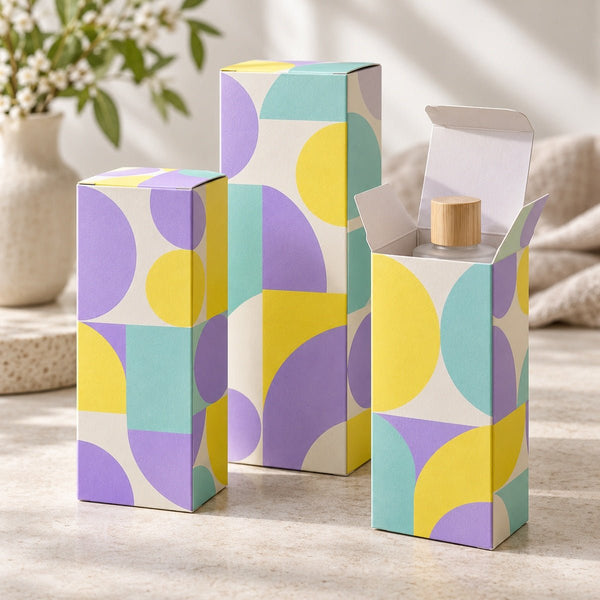
The tuck flap has a curved tongue that slides inside the box, and small "friction locks" on the dust flaps help hold it shut. That makes the box quick to pack by hand and easy for the customer to open and close.
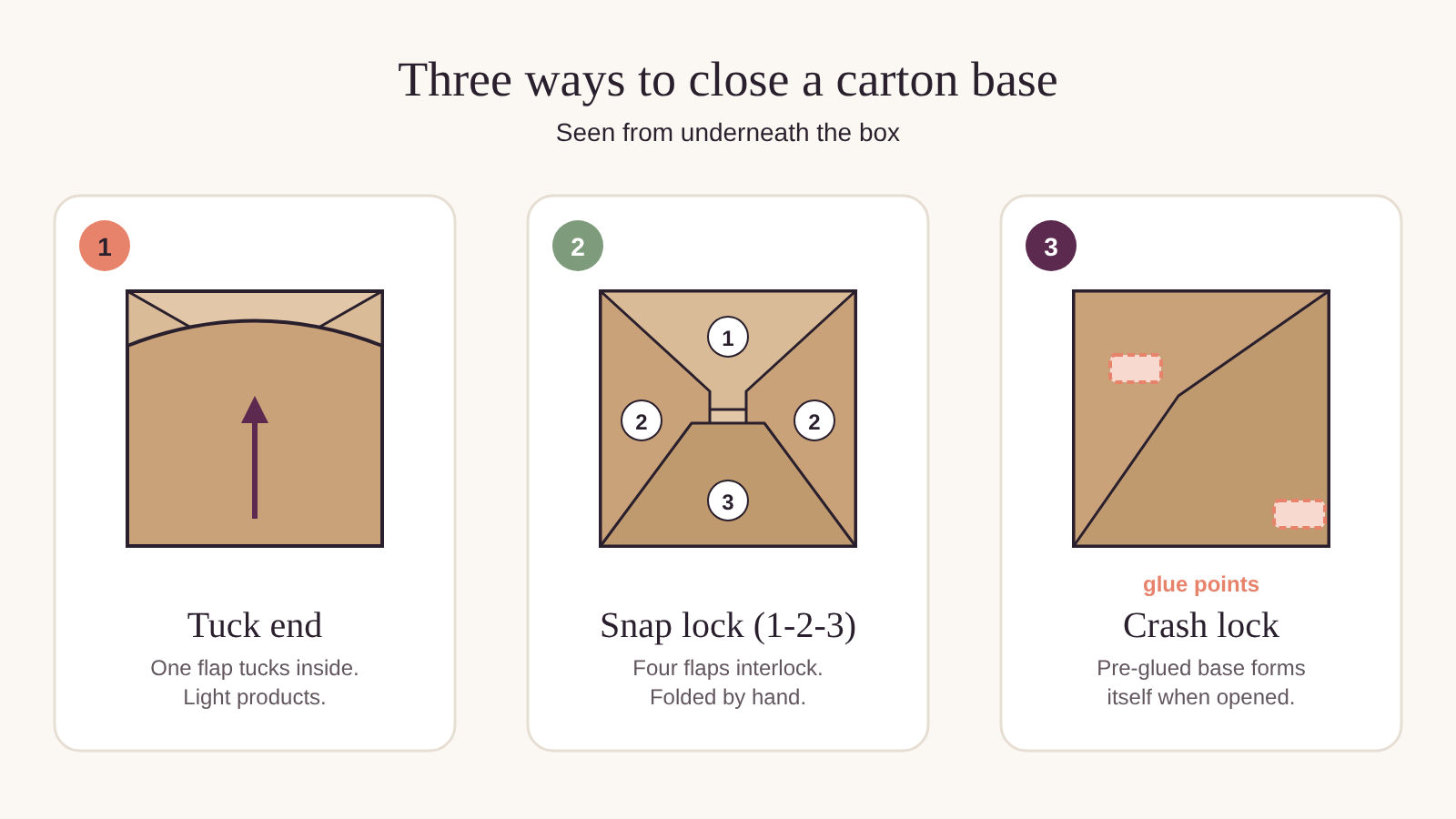
Reverse tuck vs straight tuck
| Reverse tuck end (RTE) | Straight tuck end (STE) | |
|---|---|---|
| How it closes | Top flap tucks from the back, bottom flap from the front | Both flaps tuck from the same side |
| Opening | The two ends open in opposite directions | Both ends open the same way |
| Common use | Cosmetics, skincare and everyday retail cartons | Cartons where both ends should look the same |
| From PackQueen | One of our standard custom carton styles | Not a standard style. Ask our team |
When a tuck end box is the right choice
- Light products. Tuck end bases hold well for light items such as serums, lip products, small jars and accessories.
- Retail shelves. Six printable sides give plenty of room for branding, product information and barcodes.
- Hand packing. Simple to fold and fill, and the box stores flat until you need it.
If your product is heavier, such as a glass jar or a bottle with weight to it, consider a snap lock or crash lock base, which supports more weight than a tuck flap.
What it means for you
The same question, answered for where your business is today.
Choose your stage at the top of the page to open the advice for you.
Start-up · under 100 units
If you're not ready for 250 custom cartons, start with stock paperboard boxes and a custom label. When you're ready, order a single full custom printed sample before your first run.
Our cosmetic carton sample is $100, reimbursed if you order within 3 months.
Growing · 100 to 2,499 units
A printed tuck end carton is often the first retail packaging a skincare or cosmetics brand orders. Settle your product sizes first so one carton size can cover several products.
Try this: check every carton against your product's widest point, including pumps and caps.
Enterprise · 2,500 units and more
Specify the carton size, board, print, finish and closure style in your packaging specification, so every reorder matches. Offset printing on paperboard suits longer runs.
Ask about gloss or matt lamination, foil, embossing or spot UV for premium lines.
Common mistakes
- 1Using a tuck base for heavy products. A heavy jar can push the bottom flap open. Use a snap lock or crash lock base.
- 2A carton that's too loose. Products rattle and the box looks underfilled. Size the carton to the product.
- 3Forgetting the inside. Paperboard cartons can be printed inside and outside, which is a simple way to add a message.
- 4Not ordering a sample. A printed sample shows the colours, size and fit before you commit to the full run.
Tuck end box questions
What is a reverse tuck end box?
What's the difference between reverse and straight tuck end?
What's the minimum order for custom tuck end boxes?
What material are tuck end boxes made from?
Can I get a sample first?
Keep reading
Retail and product boxes
Ready for your own printed cartons?
Tell us your product sizes and quantities. Our Melbourne team will recommend the right carton style and send a digital proof within 1 business day of receiving your artwork.