


Guide / Box & packaging styles / Chapter 2.6
Crash lock (auto bottom) boxes.
Open the box and the base forms itself. Here's how a crash lock bottom works, why it's the fastest carton to pack, and when it's worth choosing over a snap lock or tuck end.
The short answer
A crash lock bottom, also called an auto lock or auto bottom, is a carton base that's partly glued when the box is made. When you open the flat box into shape, the base folds and locks into place by itself. It's the quickest carton to pack, and the base generally suits heavier products, depending on the carton size, board and your product's weight. Test a sample with the real product. We make custom printed crash lock boxes in 285gsm paperboard, offset printed, from 250 units.
How a crash lock base works
A crash lock box is glued in two places during production: the side seam, like every folding carton, and parts of the base flaps. The box still ships flat. When you squeeze it open into a tube, the pre-glued base flaps swing into position and lock together, forming a solid base in one movement.
The top usually closes with a standard tuck flap, so the customer opens the box the same way as any carton.
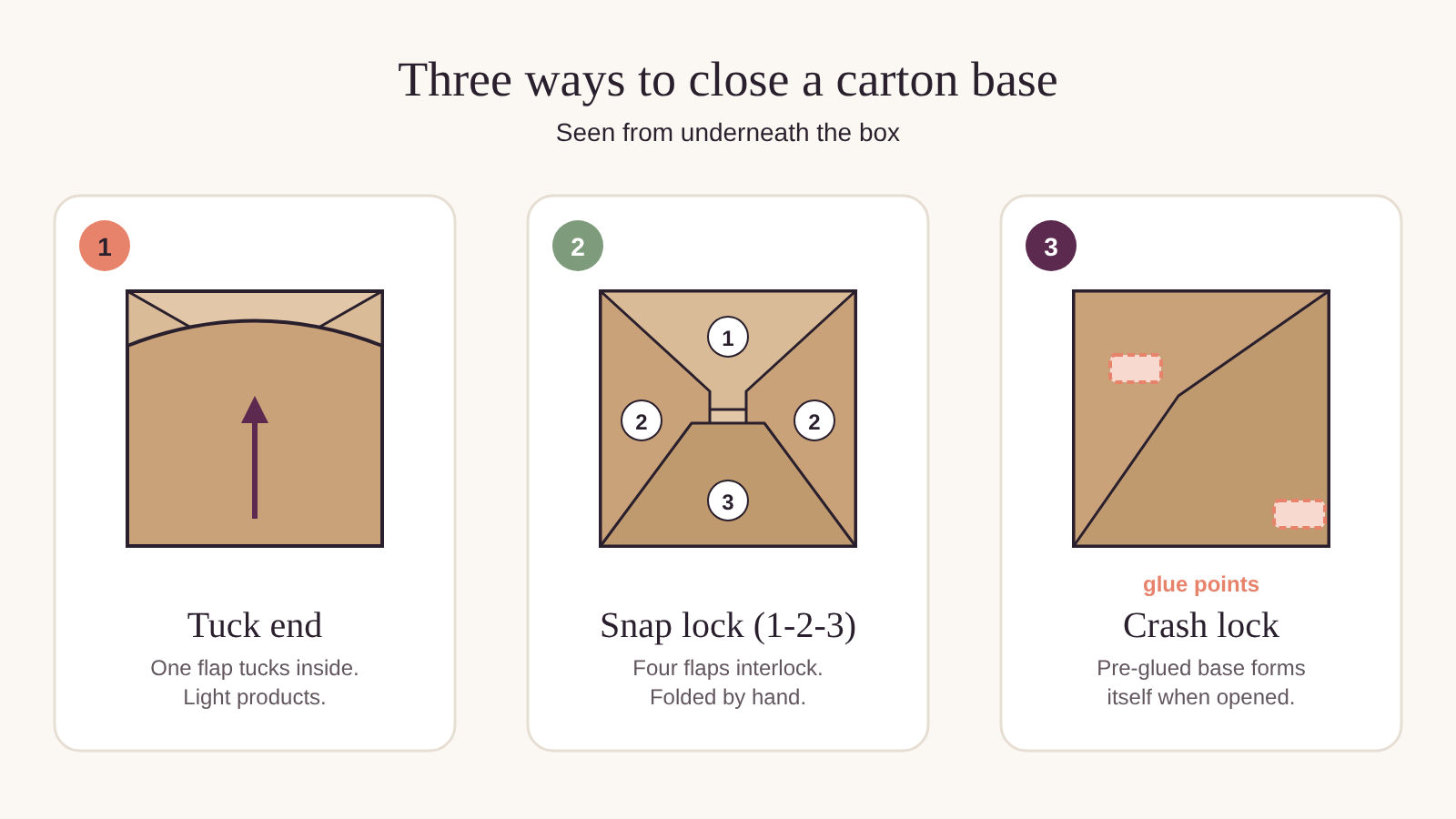
Crash lock compared
| Crash lock | Snap lock | Tuck end | |
|---|---|---|---|
| How the base forms | Automatically when opened | Folded by hand in sequence | One flap tucked in |
| Packing speed | Fastest | A few seconds per box | Quick |
| Weight it holds | Medium to heavier products | Medium to heavier products | Light products |
| Arrives | Flat | Flat | Flat |
When crash lock makes sense
- You pack a lot of cartons. Every second saved per box matters when you're filling hundreds or thousands.
- Your product is heavier. A crash lock base supports glass jars, bottles, candles and boxed sets well.
- Consistency matters. The base forms the same way every time, so there's less room for a box to be folded wrongly.
- Several people pack. It's quick to learn, so new packers can start straight away.
For small runs packed by hand, a snap lock base is often just as practical. Our team can help you choose.
What it means for you
The same question, answered for where your business is today.
Choose your stage at the top of the page to open the advice for you.
Start-up · under 100 units
For a first run of a heavier product, a snap lock base is usually enough. Keep crash lock in mind as your volumes grow.
Order a single full custom printed sample to check the size and fit.
Growing · 100 to 2,499 units
If packing time is becoming a bottleneck, crash lock cartons can speed things up without changing your design.
Try this: time 20 snap lock boxes and 20 crash lock boxes, then work out the difference across a month of orders.
Enterprise · 2,500 units and more
Crash lock is a common choice for longer runs and busy packing lines. Specify the base style, carton size, board and finish for each product.
Test the base with your heaviest product, and check how the cartons stack in your shipping cartons.
Common mistakes
- 1Forcing the base the wrong way. Don't push a formed crash lock base against its intended folds, as this can weaken the glued flaps. Form boxes as you need them, and ask us if you need to reflatten a particular design.
- 2Choosing crash lock for very light products. A tuck end box may do the job for less.
- 3Not checking the base with the real product. Always test with your heaviest item before a full run.
- 4Forgetting the lid. The top still needs to close neatly. Check the tuck flap fits over any pump or cap.
Crash lock box questions
What is a crash lock box?
Is crash lock the same as auto lock bottom?
Is a crash lock stronger than a snap lock?
What's the minimum order for crash lock boxes?
Do crash lock boxes ship flat?
Keep reading
Retail and product boxes

Packing a lot of cartons?
Tell us your products, weights and how many you pack. Our Melbourne team will recommend the right carton base, usually within 1 business day.