By Monique, Founder of PackQueen · Packaging Strategy · 8 min read
3 Things You'll Take Away From This Article
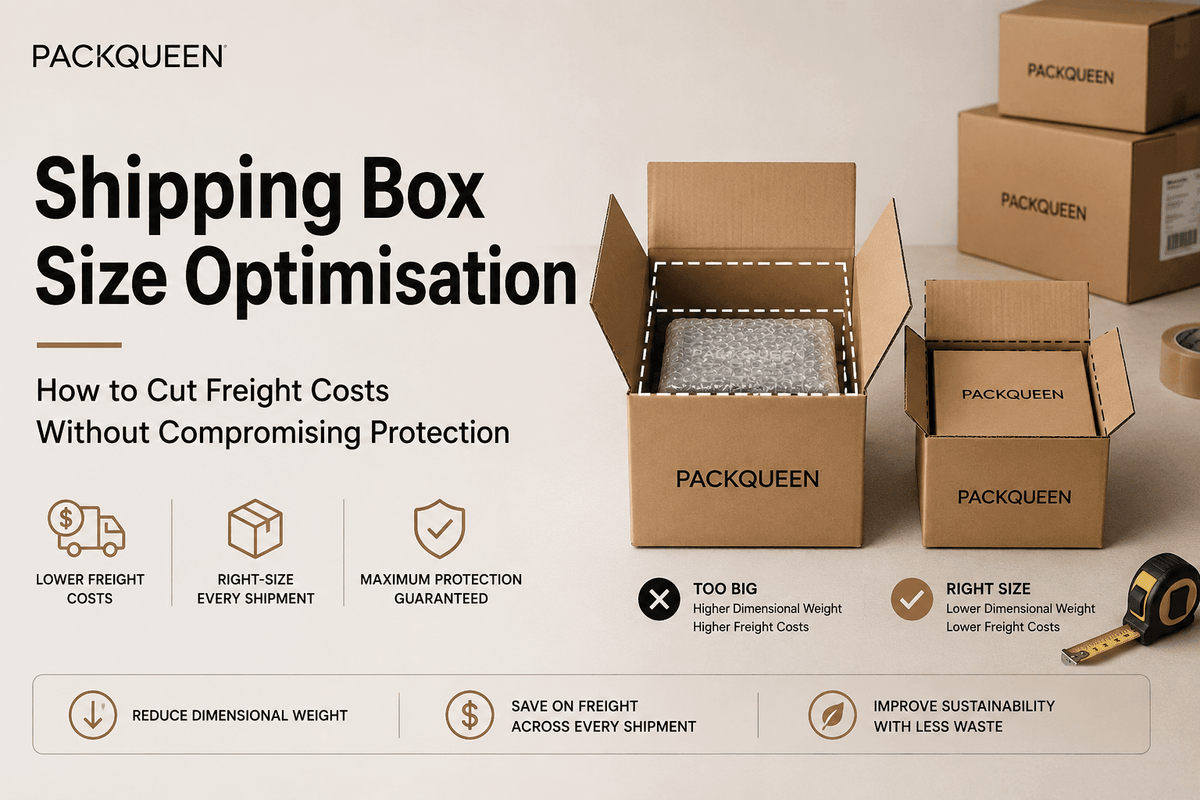
➡ The wrong box size is one of the most expensive mistakes in ecommerce. Oversized shipping boxes trigger dimensional weight charges that can significantly inflate your freight costs — often without you realising it.
➡ Right-sizing protects your product AND your margins. A well-chosen shipping box reduces product movement, minimises void fill, and cuts dimensional weight — without sacrificing protection.
➡ Box size optimisation is a one-time effort with ongoing returns. Auditing your box range against your actual product mix typically takes a few hours. The freight savings compound with every order you ship.
Why Box Size Is a Freight Cost Problem
Hi, I'm Monique — founder of PackQueen. Today I want to talk about something most ecommerce businesses are losing money on without realising it: their shipping boxes are too big.
Dimensional weight pricing is how every major Australian freight carrier charges for parcels that are light but large. If your box takes up a lot of space in a delivery van or aircraft — even if it weighs almost nothing — you pay for the space, not the weight.
📐 Dimensional weight formula: (Length/100 × Width/100 × Height/100 in cm) x 250 = Dimensional Weight (kg).
For example, if you have a parcel that is 40 x 30 x 20cm. This would be the calculation
0.40 x 0.30 x 0.20 = 0.024 * 250 = 6kg.
If this number is greater than the actual weight in kg, you pay for dimensional weight. Most oversized boxes trigger this on almost every shipment.
How Dimensional Weight Pricing Works in Australia
| Scenario | Box Dimensions | Actual Weight | Dim. Weight | Avoidable Cost |
|---|---|---|---|---|
| Current (oversized) | 40×30×20cm | 0.8kg | 6kg | Baseline |
| Right-sized option | 28×20×15cm | 0.8kg | 2.1kg | Save ~$3–6/order |
| At 500 orders/month | — | — | — | Save $1,500–$3,000/month |
| At 1,000 orders/month | — | — | — | Save $3,000–$6,000/month |
The 5-Step Box Size Optimisation Process
Step 1 — Map your product range
List every product you ship, along with its dimensions and weight. Group products that are typically ordered together. This gives you the product mix you need to design your box range around.
Step 2 — Measure your current boxes
Note the dimensions and typical void fill used for each product in each current box. Calculate the dimensional weight for each combination. This is your current freight cost baseline.
Step 3 — Design your ideal box range
For most ecommerce businesses, 2–4 box sizes cover 90%+ of their order mix. The goal is to find the smallest box that fits each product category comfortably — with minimal void fill.
- Rule of thumb: allow 10–20mm clearance on each side for protective cushioning. More than that and you're paying for air.
- For fragile products: double-wall boxes or inner padding may be needed — but the outer box should still be as small as safely possible
- For multi-product orders: a larger box that fits your most common bundle is better than an ad-hoc oversized box
Step 4 — Calculate the freight saving
For each product category, compare the dimensional weight of your current box vs the right-sized alternative. Multiply the saving per shipment by your monthly order volume. This is your annual saving.
Step 5 — Order samples and test
Before committing to a full production run, order samples of your new box sizes and test them with your actual products. Check for: product movement, structural integrity, pack time, and void fill requirement.

Box Size Recommendations by Product Category
| Product Category | Recommended Box Type | Key Considerations | Avoid |
|---|---|---|---|
| Clothing & apparel | Mailer box or poly mailer | Lightweight — dimensional weight risk high with large boxes | Oversized boxes with paper fill |
| Skincare & cosmetics | Snug mailer box | Protect glass/pump packaging from movement | Too much void fill — increases dim. weight |
| Candles | Double-wall mailer, snug fit | Weight moderate — protect wax from impact | Thin single-wall in oversized box |
| Jewellery | Small mailer box or rigid gift box | Minimal movement needed — light product | Large box = high dim. weight for light item |
| Books / stationery | Flat mailer or book wrap | Near product dimensions — minimal clearance | Square boxes for flat products |
| Food / pantry | Right-sized RSC or mailer | Check food-safe specification | Oversized box with food movement inside |
| Homewares / ceramics | Double-wall RSC with padding | Protection priority — double-wall essential | Single-wall box, insufficient padding |
When to Use Void Fill — and When to Eliminate It
When void fill IS necessary
- Fragile products (glass, ceramics, electronics) where movement = breakage risk
- Heavy products where product weight could puncture the box base
- Multi-product orders where items need separation to prevent contact damage
- Products with protruding parts that could damage the box interior
When void fill can be eliminated
- Right-sized mailer boxes where the product fits snugly with minimal movement
- Clothing and soft goods that can absorb minor movement without damage
- Single-product orders shipped in purpose-designed boxes
- Products wrapped in tissue paper or another interior layer
| Void Fill Type | Best Use | Recyclable? | Dim. Weight Impact |
|---|---|---|---|
| Crumpled kraft paper | Light fill, movement prevention | Yes — kerbside | Moderate |
| Honeycomb paper wrap | Fragile item wrapping | Yes — kerbside | Low |
| Bubble wrap | Fragile, heavy items | REDcycle only | High |
| Air pillows | Multi-product separation | REDcycle only | Very high |
| Tissue paper | Light products, aesthetics | Yes — kerbside | Very low |
| Moulded pulp inserts | Consistent fragile products | Yes — kerbside | Very low |
Customer Savings
Recently we assessed a business who came to us after noticing their freight costs had increased Their best-selling product was being shipped in a box 40% larger than necessary, packed with crumpled paper. Their dimensional weight per order was nearly triple the product's actual weight.
What we changed
- Redesigned box range from 3 to 4 sizes — but all right-sized to actual product combinations
- Eliminated air pillow void fill entirely — replaced with honeycomb paper wrap for fragile items
- Introduced double-wall construction — for their heaviest products in the smaller right-sized boxes
Browse our full range of shipping boxes or get in touch to discuss right-sizing your packaging range.
Frequently Asked Questions
1. How do I calculate dimensional weight for my parcels?
| Box Size (cm) | Dimensional Weight | Actual Weight | Charged Weight |
|---|---|---|---|
| 40×30×20 | 6 kg | 0.5 kg | 6 kg |
| 30×20×15 | 2.25 kg | 0.5 kg | 2.25 kg |
| 25×15×10 | 0.93 kg | 0.5 kg | 0.93 kg |
| 20×15×10 | 0.75 kg | 0.5 kg | 0.5 kg ✓ |
2. Do right-sized boxes provide less protection than larger boxes?
When done correctly, a right-sized box provides equal or better protection. Here's why:
- Less product movement — products can't shift around inside a snug-fitting box
- No void fill failure — void fill can compress or shift in transit, leaving products unprotected
- Structural integrity — a smaller box has more compressive strength relative to its contents
- Impact distribution — an oversized box can flex and collapse on impact in ways a fitted box won't
The key is choosing the right wall thickness. For fragile products in right-sized boxes, double-wall corrugated provides significantly better protection than single-wall in an oversized box.
3. What if my products vary a lot in size — can I still right-size?
- Analyse your order mix. What percentage of orders are single-item vs multi-item? What are your top 5 most common order combinations?
- Design around the 80/20 rule. If 80% of your orders contain 1–2 products, right-size for that. The remaining 20% can use a larger standard box.
- Accept some variation. A 3–4 box range covering your main product combinations will capture most of the saving.
- Use mailer boxes for smaller SKUs. Mailer boxes are available in more size variations than standard RSC boxes — easier to right-size for varied product ranges.
4. How long does a box size audit take, and do I need external help?
A basic box size audit can be completed in a few hours with your own team. Here's a simple DIY process:
- List your top 10 products by order volume
- Measure each product (L × W × H) and record actual weight
- Note the current box used for each product and its dimensions
- Calculate dimensional weight for each current box
- Identify the smallest box size that fits each product with 10–20mm clearance
- Calculate the dimensional weight saving and multiply by monthly order volume
The PackQueen team can help with the next step — finding the right box specifications to match your audit findings. Get in touch to discuss your requirements.
Monique | Founder, PackQueen
packqueen.com.au · Shipping Boxes & Ecommerce Packaging for Australian Businesses