


Guide / Materials & board grades / Chapter 3.3
Single wall vs double wall.
Double wall board is stronger, but it's also heavier and thicker, which can add to freight costs. Here's how to tell which one your products need.
The short answer
Single wall board has one layer of flute between two liners. It suits most everyday shipping, mailer boxes and light to medium products. Double wall board has two layers of flute between three liners, usually B and C flute together, called BC flute. It suits heavy goods, fragile items travelling long distances, removals and cartons stacked high. Choose double wall when the load needs it, not by default.
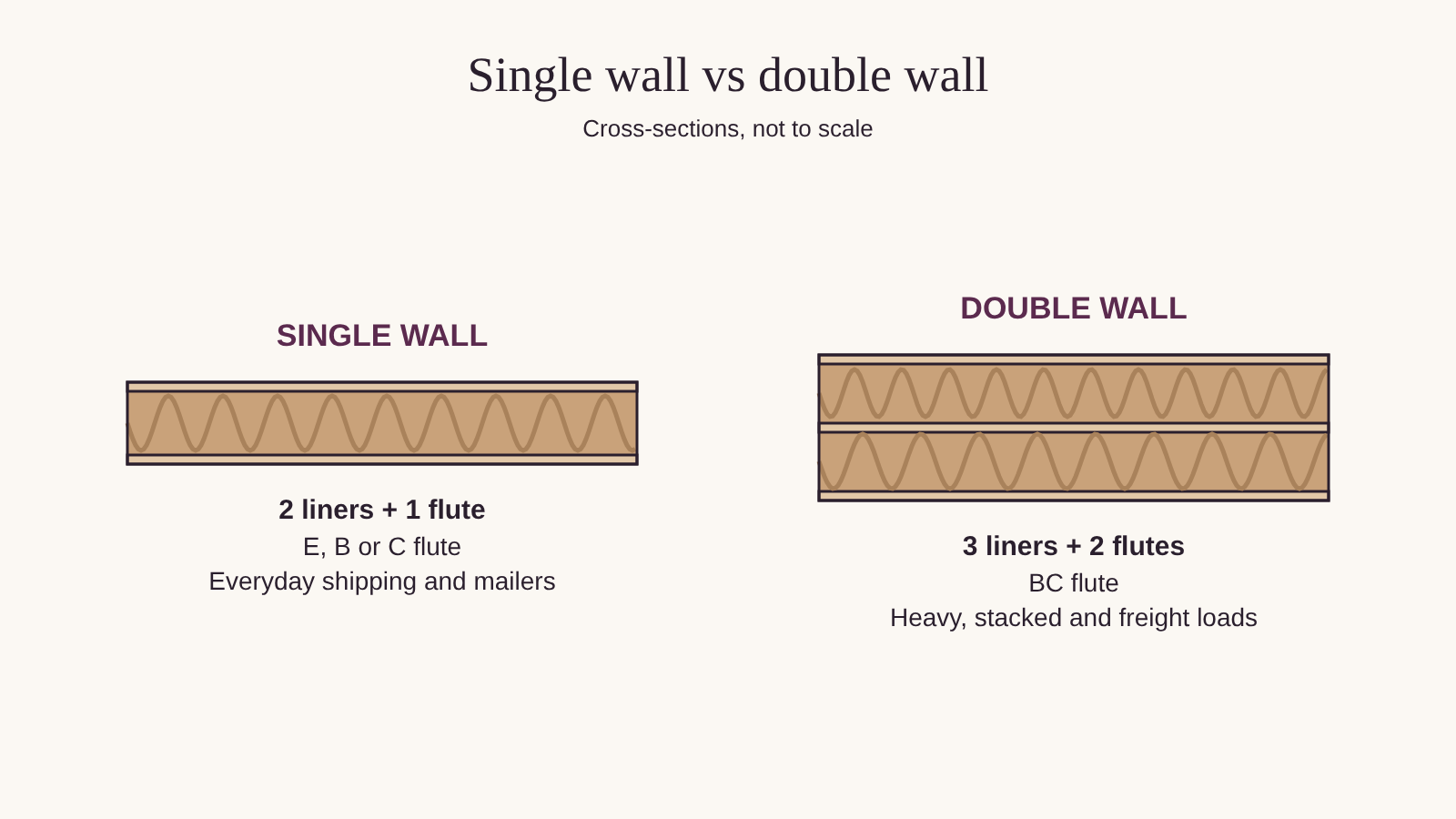
How they're built
Corrugated board is a sandwich of flat liners and wavy flutes. In single wall board there's one flute: liner, flute, liner. In double wall board there are two flutes: liner, flute, liner, flute, liner.
The extra layer makes the board much thicker (our BC double wall is about 7 mm, against about 1.5–4 mm for single wall) and, with board of similar quality, adds a lot of stacking and crush strength. Our flute chapter explains each flute size in detail.
Single wall vs double wall at a glance
| Single wall | Double wall | |
|---|---|---|
| Structure | One flute, two liners | Two flutes, three liners |
| Common flutes | E, B or C | BC |
| Approximate thickness | About 1.5–4 mm, depending on flute | About 7 mm |
| Best for | Everyday shipping, mailers, light to medium items | Heavy goods, removals, freight, high stacks |
| Weight | Lighter | Heavier, adds to freight weight |
| Printing | E flute prints best | Mostly plain or simple print |
When to choose double wall
- Heavy contents, where the bottom and seams of a single wall box could fail.
- High stacks in storage, warehouses or on pallets, where the bottom cartons carry the weight of everything above.
- Long or rough journeys, such as interstate freight with several handling points.
- Removals, where boxes are packed heavy, lifted often and stacked in trucks.
- Fragile, valuable items where the cost of a breakage is high.
For most light and medium products sent to customers, single wall in the right flute, with a box that fits well, does the job and keeps weight and postage down. For heavy items, see our super strong boxes and check the board listed on each product.
What it means for you
The same question, answered for where your business is today.
Choose your stage at the top of the page to open the advice for you.
Start-up · under 100 units
Start with single wall. Most stock mailers and postage boxes are made in the flute that suits their size. Only step up if damage is a real problem.
If something arrives damaged, check the fit and filler first. A better fit often fixes damage without heavier board.
Growing · 100 to 2,499 units
Look at your heaviest products and longest routes. Those are where double wall can pay for itself. Keep single wall for everything else.
Try this: send the same heavy item in single and double wall boxes to a distant address, and compare.
Enterprise · 2,500 units and more
Specify board by product and route in your packaging specification. Test stacked loads before switching, because double wall changes freight weight and the outside size of the carton.
Re-check pallet patterns if you change board, since thicker walls make each carton bigger.
Common mistakes
- 1Using double wall for everything. It adds weight and cost to every shipment. Use it where the load needs it.
- 2Upgrading board to fix a fit problem. A loose box with no filler will still damage products, even in double wall.
- 3Forgetting the outside size grows. Thicker board adds to the external dimensions, which can change postage and pallet counts.
- 4Judging strength by feel. Strength depends on the flute, the liners and how the box is built, not only thickness.
Single and double wall questions
What is double wall cardboard?
Is double wall always stronger?
Is single wall strong enough for posting?
Does double wall cost more to ship?
How do I know which board a box uses?
Keep reading
Shop by strength


Not sure which board you need?
Send us your product's size and weight and how it travels. Our Melbourne packaging team will recommend single or double wall, usually within 1 business day.