By Monique, Founder of PackQueen · Packaging Strategy · 8 min read
3 Things You'll Take Away From This Article
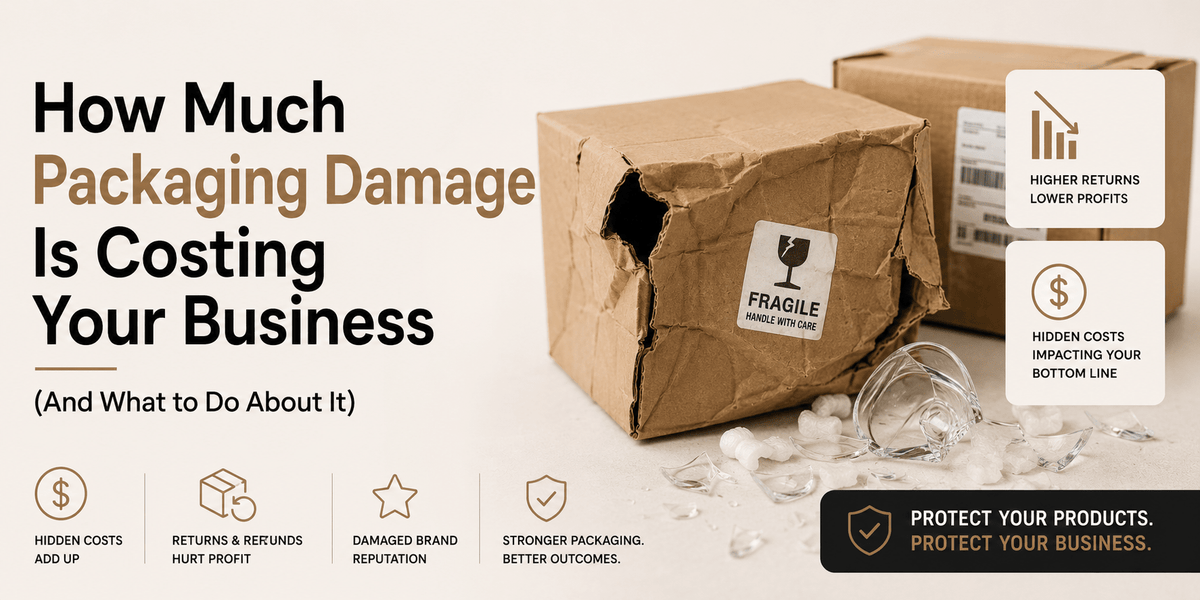
➡ Packaging damage costs far more than most businesses calculate. The visible cost is the replacement and return freight. The invisible cost — lost CLV, negative reviews, churn — is typically 5–10x larger.
➡ Most packaging damage is preventable with the right protective packaging. Box sizing, wall thickness, void fill and seal integrity account for the vast majority of transit damage.
➡ Fixing your protective packaging pays for itself almost immediately. The cost of upgrading is almost always lower than a single month of damage-related losses when calculated correctly.
The Real Cost of a Damaged Order
Hi, I'm Monique — founder of PackQueen. When businesses tell me they have a packaging damage problem, they usually quote their return rate and their replacement product cost. Those are the numbers they can see. But the true cost of a damaged order is much larger.
| Cost Category | Typical Cost | Visible? |
|---|---|---|
| Replacement product cost | $10–$200+ depending on product | Yes |
| Return freight | $8–$25 per return | Yes |
| Re-packing and admin time | $5–$15 per incident | Partially |
| Customer service handling | $8–$20 per incident | Partially |
| Lost repeat purchase (1 year CLV) | $50–$500+ per customer | No |
| Negative review impact | $100–$1,000+ per bad review | No |
| Total true cost per damaged order | $180–$1,700+ | Mostly hidden |
A 2% damage rate on 500 monthly orders is 10 damaged orders per month. At a conservative true cost of $200 per incident, that's $2,000 per month — $24,000 per year — in packaging damage losses.
⚠️ A single negative review about damaged packaging can cost a business dozens of future customers. The visible cost of damage is a fraction of the real cost.
The 6 Leading Causes of Packaging Damage in Transit
1. Undersized or thin boxes
Single-wall cardboard boxes that aren't rated for the weight of the product inside will compress or puncture in transit.
Fix: match wall thickness to product weight. Single-wall for under 5kg, double-wall for 5–15kg, triple-wall for heavy or fragile items.
2. Insufficient or incorrect void fill
A product that can move inside its box during transit will sustain impact damage. Void fill that compresses (bubble wrap, crumpled paper) can fail mid-journey, leaving products unprotected.
Fix: right-size the box to minimise movement, and use void fill that maintains its cushioning (honeycomb paper, moulded pulp) rather than compressing over time.
3. Inadequate product-specific protection
Different products need different protective approaches. Glass needs wrapping. Electronics need anti-static and cushioning. Generic void fill doesn't address product-specific vulnerabilities.
Fix: map your product range against specific protection requirements and design packaging accordingly.
4. Seal failure
Boxes that open in transit expose products to contamination, humidity and further impact damage.
Fix: use self-locking mailer boxes where possible; for RSC boxes, use H-tape pattern and pressure-sensitive tape rated for the package weight.
5. Stacking pressure
In courier vehicles and warehouses, parcels are stacked. A box rated for its own contents may not be rated for the weight of boxes stacked on top of it in transit — the leading cause of crushed packaging.
Fix: double-wall construction and correctly sized boxes (not overfilled) significantly increase stacking strength.
6. Moisture exposure
Parcels left on doorsteps or in outdoor collection points are exposed to moisture. Thin cardboard degrades rapidly when wet, compromising structural integrity.
Fix: consider moisture-resistant coatings for outer boxes, poly bags for inner product protection, or moisture-indicating tape for high-risk deliveries.
Protective Packaging by Product Type
| Product Category | Risk Profile | Recommended Protective Packaging | Wall Thickness |
|---|---|---|---|
| Glassware / ceramics | High fragility | Honeycomb paper wrap + moulded pulp | Double-wall minimum |
| Electronics | Fragile, moisture-sensitive | Anti-static wrap + foam corners + rigid box | Double-wall |
| Candles | Moderate fragility, wax damage | Tissue wrap + snug-fit box | Single or double-wall |
| Skincare (pumps/glass) | Pump damage, spillage risk | Pump locked + tissue + snug mailer | Single-wall, snug fit |
| Clothing & apparel | Low fragility, moisture risk | Poly bag inner + tissue + mailer box | Single-wall |
| Jewellery | Low weight, high value | Jewellery box + padded insert + mailer | Single-wall, rigid outer |
| Food (dry goods) | Crush risk, moisture risk | Food-grade inner bag + kraft box | Single-wall, food-safe |
| Large homewares | Heavy, bulky, breakage risk | Foam corners + kraft wrap + triple-wall | Double or triple-wall |
The Protective Packaging Audit: What to Check
Box integrity check
- Does the box maintain its shape when the product is inside and the lid closed?
- Is the wall thickness appropriate for the product weight?
- Is the box sealed securely — self-locking, or adequately taped?
- Does the box maintain its shape under pressure from above?
Product movement check
- When the packed box is shaken gently, can you hear the product moving?
- If you tilt the box in each direction, does the product shift?
- Is there more than 20mm of empty space around the product on any side?
Drop test
Pack a box as you would for dispatch. Drop it from waist height (approximately 1m) onto a hard floor — flat, on its side, and on its corner. Open it. Is the product undamaged?
📦 Most businesses who do this test for the first time are surprised by the result. The good news: if your product fails, the fix is usually straightforward and affordable.
How Protective Packaging Saved a Business During Peak Season
A ceramics artist had been running a successful ecommerce business for two years when Black Friday hit and her damage rate jumped from 2% to nearly 9% in a single week.
She'd been using single-wall cardboard boxes with crumpled kraft paper void fill — adequate for low volumes, but not for the heavily loaded courier vehicles and aggressive handling of peak season.
The problems we identified
- Single-wall boxes compressing under stacking weight
- Crumpled paper void fill compressing after first major impact, leaving ceramics unprotected
- No product-specific wrapping — ceramics were contacting the box wall directly
The protective packaging solution
- Switched to double-wall corrugated boxes — significantly higher stacking strength
- Added honeycomb paper wrap — around each ceramic piece, maintaining cushion even after multiple impacts
- Right-sized the box range — reducing product movement to near-zero for the two most common product sizes
Browse our full range of protective packaging or get in touch and we'll help you find the right solution for your products.

Frequently Asked Questions
1. What damage rate is acceptable for an ecommerce business?
| Damage Rate | Assessment | Action Required |
|---|---|---|
| Under 0.5% | Excellent — protective packaging is working well | Monitor quarterly |
| 0.5–1% | Acceptable — some optimisation possible | Review packaging for highest-damage products |
| 1–3% | Concerning — likely a specific packaging gap | Audit all product packaging configurations |
| 3–5% | Serious — significant cost and brand impact | Immediate packaging review and upgrade |
| Above 5% | Critical — requires urgent action | Full packaging audit + carrier review |
2. How do I track my actual damage rate?
- Track all customer contacts mentioning damage or product condition (email, reviews, DMs, chat)
- Include orders where you issued a refund or replacement, even if the customer didn't explicitly complain
- Divide total damaged orders by total orders dispatched in the same period
- Track monthly and look for patterns — specific products, specific courier routes, specific seasons
A Shopify or WooCommerce tag for 'damaged order' applied at the time of resolution makes this significantly easier to track over time.
3. Should I use bubble wrap or paper void fill for fragile products?
| Material | Protection | Environmental | Best For |
|---|---|---|---|
| Bubble wrap | High (initially) | Poor — REDcycle only | Heavy, sharp-edged items |
| Honeycomb paper wrap | High (sustained) | Excellent — kerbside | Fragile, delicate items |
| Kraft paper crumple | Medium | Excellent — kerbside | Lightweight fill |
| Moulded pulp inserts | Very high (custom) | Excellent — kerbside | Consistent fragile products |
| Air pillows | Medium | Poor — REDcycle only | Multi-product separation |
For most ecommerce businesses shipping fragile products, honeycomb paper wrap is the best all-round choice: strong, sustainable, kerbside recyclable, and acceptable cost.
4. Is it worth upgrading to double-wall boxes for all products, or only some?
- Use double-wall when: product weight exceeds 3–4kg, product is fragile, product is high-value (replacement cost above $50), or shipping routes involve interstate transit or peak periods
- Single-wall is sufficient when: product weight is under 3kg, product is non-fragile (clothing, books, soft goods), box is right-sized with minimal product movement
The cost difference between single and double-wall is typically $0.40–$1.20 per unit — significantly less than the cost of a single replacement + return for most products.
Get in touch with the PackQueen team to discuss the right protective packaging for your specific products and shipping patterns.
Monique | Founder, PackQueen
packqueen.com.au · Protective Packaging & Shipping Solutions for Australian Businesses