By Monique, Founder of PackQueen · Packaging Strategy · 8 min read
3 Things You'll Take Away From This Article
➡ Speed and protection aren't in conflict — the right packaging delivers both. Most businesses treat protective packaging as something that slows packing down. The best-performing fulfilment operations have packaging that's faster to apply AND better at protecting the product.
➡ The operational cost of slow packing compounds dramatically at peak volume. At 5× normal volume, a packing process that takes 3 minutes longer per order costs 25+ hours of extra labour.
➡ The key is matching protective packaging to the specific protection need — not defaulting to generic void fill. Generic void fill is slow to apply, inconsistent, and often provides less protection than targeted alternatives.
The Speed-Safety Trade-Off That Doesn't Have to Exist
Hi, I'm Monique — founder of PackQueen. Here's what I've found working with businesses across every category: the best protective packaging is almost always also the fastest to apply. That's because the best protective packaging is designed for the specific product, fits correctly, and requires no adjustment or improvisation.
⚡ The fastest packing process is the one where every decision has been made in advance. The right protective packaging eliminates decisions at the packing station — which is where the time is.
The Slowest Protective Packaging Approaches — and Faster Alternatives
| Slow Approach | Why It's Slow | Faster Alternative | Speed Gain |
|---|---|---|---|
| Crumpled paper void fill | Requires judgement on quantity; inconsistent application | Right-sized box (no fill needed) or honeycomb wrap | 2–4 min/order |
| Bubble wrap torn from a roll | Measuring, cutting, wrapping — multiple steps | Honeycomb paper wrap (pre-cut sheets) | 1–3 min/order |
| Generic foam blocks | Cutting to size, positioning — slow and inconsistent | Moulded pulp inserts (product-specific) | 3–6 min/order |
| Double-boxing (box in a box) | Full second packing step; doubles handling time | Right-wall-thickness single box | 3–8 min/order |
The Fastest Protective Packaging System for Each Product Type
Clothing and Soft Goods — Eliminate the Protection Step
For clothing, the most efficient protective packaging is to eliminate the protection step entirely by right-sizing the box so the product fits snugly with no movement.
- Flat-fold clothing in a consistent fold — the same fold, same dimensions, every time. Fits the box without adjustment.
- Tissue paper wrap — serves double duty as protection (prevents snag on cardboard) and interior presentation.
- No void fill needed — a correctly sized box with correctly folded clothing has no need for fill. Snug is safe.
Pack time per order with this system: 2–3 minutes. Pack time with a generic box and paper fill: 5–7 minutes.
Glass, Ceramics and Fragile Products — Honeycomb Wrap Over Bubble Wrap
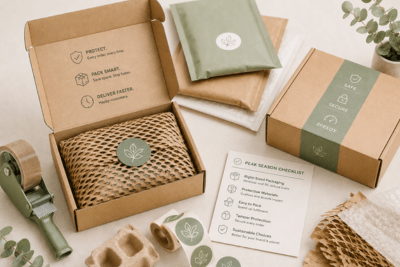
For fragile products, the fastest protective approach at peak is pre-cut honeycomb paper sheets in standardised sizes for each product:
- Pre-cut sheets = no measuring or tearing — grab, wrap, done. No decisions.
- Self-locking structure — honeycomb wrap holds its position without tape, reducing the securing step
- Consistent protection — the same sheet of the same size provides the same protection every time, regardless of who's packing
- Kerbside recyclable — adds to your sustainability story
Implementation: pre-cut your standard honeycomb sheets before peak season begins. Stack them at the packing station in product-matched sizes. Every packer grabs the right sheet, wraps, places. No decisions. No waste. No time.
Cosmetics and Skincare — Snug Mailers Over Void Fill
Most cosmetics are damaged by movement, not impact — the pump that activates, the lid that cracks against the box wall. The fastest protection is a box that fits:
- Mailer box sized to the product — specifically, to the product plus its tissue wrap. No movement = no damage.
- Pump lock as a standard step — 5 seconds to lock every pump. Zero seconds to handle a spillage complaint.
- Tissue wrap as protection AND presentation — one step that protects the product surface and creates the interior experience.
Multi-Product Orders — Dividers Over Loose Fill
The fastest safe approach for products that can contact each other in transit:
- Card dividers — pre-cut card inserts that separate products in specific positions. Placed once. Stay in position throughout transit.
- Moulded pulp inserts — for consistent multi-product configurations, insert tray, place products, close. 30 seconds.
Setting Up Your Peak Season Packing Station for Maximum Speed
- Dominant hand flow — for right-handed packers, materials should flow left to right. Eliminate cross-body reaches.
- Vertical storage — boxes staged flat-folded vertically take up less bench space and are faster to access
- Pre-staged elements — tissue pre-folded, honeycomb wrap pre-cut, insert cards counted into per-order stacks. All done before packing begins.
- Product within arm's reach — the product should travel the minimum possible distance from storage to box.
- Label at the end — the box is fully packed and sealed before the label is applied.
Pre-peak preparation tasks
| Task | When | Speed Impact |
|---|---|---|
| Pre-cut honeycomb wrap to standard sheet sizes | 1 week before peak | 1–2 min per order saving |
| Pre-fold tissue paper to box dimensions | 2 days before peak | 30–60 sec per order saving |
| Count insert cards into per-order stacks | 2 days before peak | 15–30 sec per order saving |
| Pre-lock all pump dispensers | Day before peak | 1 min per pump order saving |
| Set packing guide at every station | Day before peak | Error reduction |
Customer Story: Saving Time Packing Orders
A Perth brand was shipping ceramics, glassware and candles with an average pack time of 12 minutes per order — three different protective approaches for three product types, each requiring judgement about quantity and placement.
The protective packaging system we rebuilt
- Non-fragile homewares: right-sized mailer boxes with tissue paper wrap. No void fill. Pack time: 3 minutes.
- Ceramics and glass: double-wall mailer boxes with pre-cut honeycomb wrap in three standardised sizes. Pack time: 4 minutes.
- Candles: custom-sized single-wall mailer boxes with tissue wrap and no void fill. Pack time: 2.5 minutes.
- Multi-product orders: card divider system for the two most common 2-product combinations. Pack time: 5 minutes.
📦 By reducing the time required to pack an order, it saved the company hours. They could handle more orders particularly in peak season.
Browse our protective packaging range — or get in touch to design a peak season packing system for your specific products.
Frequently Asked Questions
1. What protective packaging is fastest for fragile items at high volume?
For most fragile items at high volume, pre-cut honeycomb paper wrap in standardised sheet sizes is the fastest reliable approach:
- No measuring — sheets are pre-cut to the correct size for each product
- No tools — honeycomb wrap doesn't require tape to hold its position in most applications
- Consistent protection — the same result every time, regardless of packer experience
- One-step application — wrap, tuck, place. Three actions. No decisions.
2. How do I calculate the labour saving from switching to faster protective packaging?
- Measure your current average pack time per order (time 20 orders, take the average)
- Estimate the expected pack time with the new protective packaging (test with 20 orders)
- Calculate the difference in minutes per order
- Multiply by your peak order volume
- Multiply by your labour cost per minute ($20/hour ÷ 60 = $0.33/minute)
Subtract the additional cost of the new packaging per order. The remainder is your net saving per peak period.
3. Is moulded pulp packaging worth the investment for my business?
| Condition | Moulded Pulp Viability |
|---|---|
| Same product shape shipped 500+ times/month | High — tooling cost is amortised quickly |
| Consistent product configuration | High — insert design is straightforward |
| High damage rate with current approach | High — protection ROI is immediate |
| Varied products, inconsistent configuration | Low — custom insert per SKU becomes cost-prohibitive |
| Under 200 units/month of any single product | Low — pre-cut honeycomb wrap is better value |
4. How do I train new team members on protective packaging standards quickly?
- The packing guide — one page, photos, step-by-step. Posted at every packing station. Read before first order packed.
- A reference box — a packed and sealed sample order at each station. Packers compare their box to the reference before closing and labelling.
- The first 10 boxes supervised — a senior team member watches and corrects the first 10 boxes.
- Quality gate inclusion — include new packers in the quality gate check rotation from day one.
The most expensive training mistake at peak: assuming new team members can figure it out from watching. Every packer needs the guide, the reference, and the supervision.
Get in touch with the PackQueen team to plan your peak season protective packaging system.
Monique | Founder, PackQueen
packqueen.com.au · Protective Packaging & Peak Season Fulfilment for Australian Businesses