By Monique, Founder of PackQueen · Packaging Strategy · 8 min read
3 Things You'll Take Away From This Article
➡ The new financial year is the best time to reset your packaging strategy. Most businesses plan their operations, marketing and budgets at the start of a new financial year — packaging deserves the same treatment.
➡ A packaging audit reveals costly problems most businesses don't know they have. Oversized boxes, unbranded interiors, missed retention opportunities and freight inefficiencies all compound over a full year of trading.
➡ Retail packaging upgrades don't require a full rebrand or a big budget. The most impactful packaging changes are often incremental — and the ROI shows up quickly in repeat purchase rates, reviews and social content.
A New Financial Year Is a New Opportunity
Hi, I'm Monique — founder of PackQueen. Every July, I have a version of the same conversation with Australian business owners.
They've just closed the books on the financial year. They've looked at their revenue, their costs, their margins. And somewhere in that review, they've noticed that something isn't quite working — but they can't put their finger on what.
In many cases, it's their retail packaging. Not because it's failing catastrophically — but because it's quietly underperforming. Costing more than it needs to. Delivering less than it should. And the gap between what their packaging is doing and what it could do is costing them customers, reviews and repeat business they'll never know they lost.
💡 Packaging is both a cost centre and a revenue driver. Treated as only the former, it underperforms. Treated as both, it pays for itself many times over.
Step 1 — Run a Packaging Audit Before You Order Anything
Before you change anything, understand what you have. A packaging audit takes less than an hour and reveals more than most businesses expect.
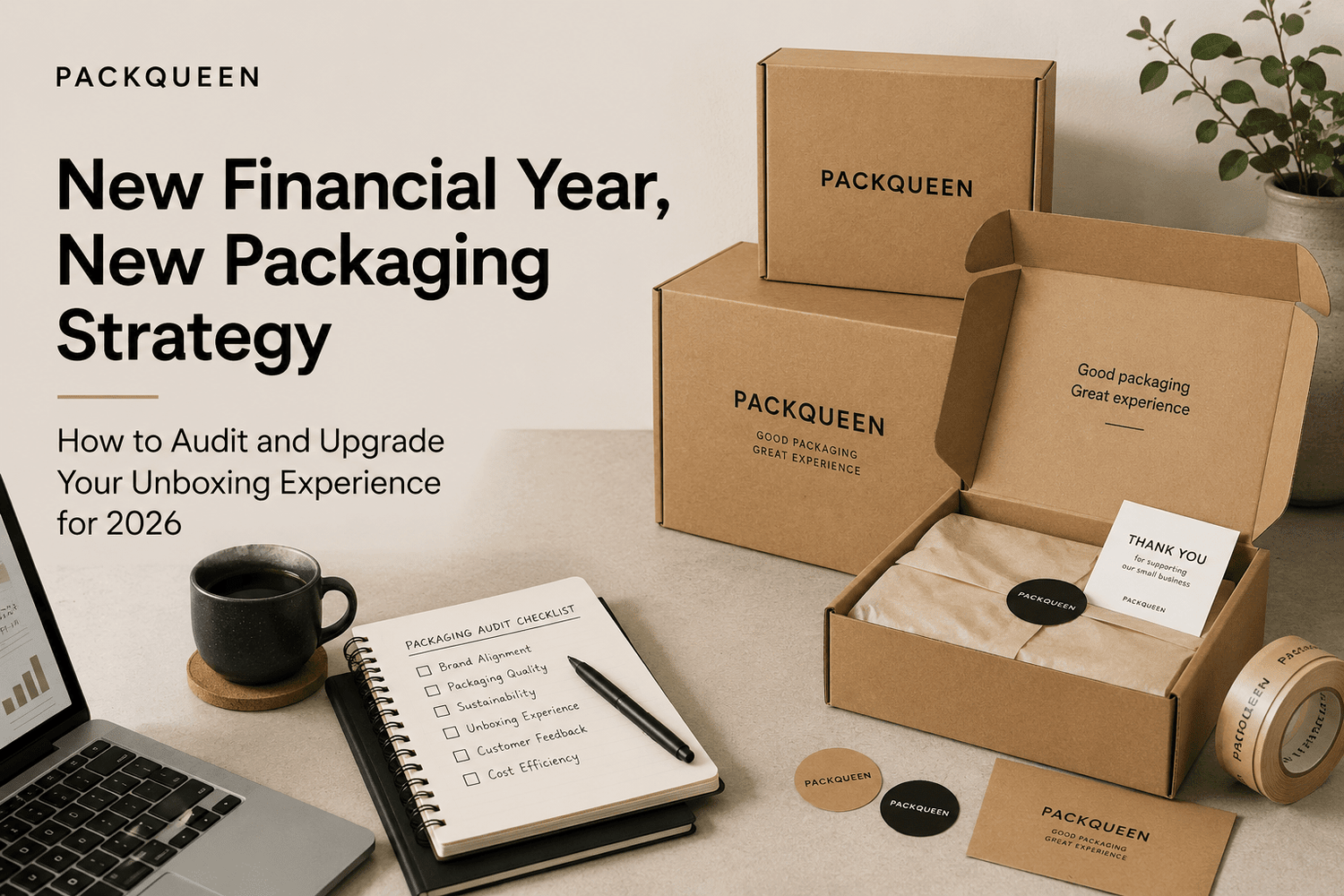
Your packaging audit checklist
| Check | What to Assess |
|---|---|
| ☐ Damage rate | What percentage of orders arrive damaged? Even 1–2% is significant at scale. |
| ☐ Box sizing | Are your boxes right-sized for your products? Is there unnecessary void fill? |
| ☐ Brand consistency | Does your packaging look and feel like your brand — inside and out? |
| ☐ Interior experience | What does a customer see when they open their order? Is there a tissue layer, an insert, a brand moment? |
| ☐ Freight costs | Have dimensional weight charges increased? Are you paying for air space in oversized boxes? |
| ☐ Fulfilment efficiency | How long does it take your team to pack an order? Are there bottlenecks? |
| ☐ Sustainability | Is your packaging recyclable? Does it reflect your brand values? |
| ☐ Cost per order | Do you know your exact packaging cost per order? Is it benchmarked? |
More than two gaps means your packaging strategy needs attention before the new financial year compounds existing problems.
Step 2 — Prioritise Your Retail Packaging Upgrades
| Upgrade | Business Impact | Cost Level | Time to Implement |
|---|---|---|---|
| Right-size your boxes | Freight cost reduction + less waste | Low–Med | 2–4 weeks |
| Add branded tissue paper | Unboxing experience + social sharing | Low | 2–3 weeks |
| Printed thank-you card / insert | Repeat purchase + loyalty uplift | Low | 1–2 weeks |
| Custom printed mailer box | Full brand experience at the door | Med–High | 3–5 weeks |
| Sustainable packaging swap | Brand values alignment + compliance | Med | 3–6 weeks |
| Retail packaging for stockists | Channel expansion readiness | Med | 4–6 weeks |
| Packaging cost audit | Baseline for all other decisions | Free | This week |
📦 Start with the packaging cost audit — it's free, takes an hour, and tells you exactly where to focus your budget for maximum return.
Step 3 — Plan for Peak Season Now, Not in October
One of the most expensive mistakes Australian ecommerce businesses make is leaving peak season packaging until the last minute. Custom retail packaging has lead times — typically 3–5 weeks from artwork approval — and those lead times extend significantly during busy periods.
| Period | Key Events | Order Packaging By | Why |
|---|---|---|---|
| September | Spring gifting, Father's Day | Late July | 3–5 week lead time + buffer |
| October–November | Black Friday / Cyber Monday prep | Late August | Peak demand = longer lead times |
| November–December | Christmas peak | September | Highest-demand period of year |
| January | Post-Christmas sales | November | Fast turnaround needed |
| June | EOFY sales | April | Time for design approval + print |
The businesses that nail peak season packaging every year are the ones that order in the quiet periods — July and August — when lead times are shorter and printers aren't at capacity.
Step 4 — Set a Packaging Budget for the Year
Most businesses don't have a formal packaging budget — they just reorder when they run out. That reactive approach costs more and delivers less than a planned annual approach.
How to set your annual packaging budget
- Calculate your current packaging cost per order (box + void fill + tissue + insert + tape + labels)
- Multiply by your projected annual order volume to get your baseline packaging spend
- Allocate 10–15% of that figure as an upgrade budget for the year
- Benchmark quarterly — as you right-size boxes and reduce void fill, your packaging cost per order should decrease
A typical ecommerce brand spending $1.50–$3.00 per order on packaging with 500 monthly orders has an annual packaging spend of $9,000–$18,000. A 10% upgrade budget of $900–$1,800 per year is enough to meaningfully improve the customer experience.

Customer Story: A New FY Reset That Changed the Business
In July two years ago, a Brisbane gift hamper business came to us for their new financial year review. They'd had a strong year by revenue — but their margins had been squeezed, and they couldn't work out why.
After a packaging audit, we found three problems: oversized shipping boxes with excessive void fill, plain unbranded exteriors despite a premium product positioning, and no interior experience — just product in paper fill, no tissue, no card, no brand moment.
What we rebuilt
- Two new mailer box sizes — right-sized for their two main hamper configurations, eliminating void fill entirely
- Custom printed exterior — their signature navy with gold logo, printed on the mailer box
- Branded tissue paper + wax seal — transforming the interior reveal
- Printed thank-you card — with a personalised message template and a 15% repeat purchase code
Explore our full range of retail packaging or get in touch to plan your new FY packaging strategy.
Frequently Asked Questions
1. How much should I budget for a packaging upgrade at the start of the new financial year?
| Average Order Value | Target Packaging Cost | Annual Budget (500 orders/month) |
|---|---|---|
| Under $40 | $0.80–$1.60 per order | $4,800–$9,600/year |
| $40–$80 | $0.80–$3.20 per order | $4,800–$19,200/year |
| $80–$150 | $1.60–$6.00 per order | $9,600–$36,000/year |
| $150+ | $3.00–$6.00 per order | $18,000–$36,000/year |
For the upgrade budget itself, target 10–20% of your current annual packaging spend. For most businesses, that's $1,000–$5,000 — enough to meaningfully upgrade the unboxing experience.
2. Is the new financial year a good time to change packaging suppliers?
It can be — especially if you've experienced quality inconsistency, long lead times, or lack of design support. What to look for in a new packaging supplier:
- Transparent lead times and clear communication
- Design support — can they help bring your brief to life?
- Flexible minimum order quantities that suit your volume
- Quality consistency — ask for samples before committing
- Australian-based support — time zone alignment matters during peak periods
3. Can I make packaging changes mid-year, or should I wait until July?
You can absolutely make changes mid-year — and if your packaging has a significant problem (high damage rate, no brand alignment, freight cost blowout), you should. Don't wait for a calendar milestone if there's a real cost to delaying.
That said, the new financial year is ideal for strategic reviews because you have full-year data, new FY budgets, the longest lead times available before peak season, and changes made now are in place for the full year ahead.
4. How do I get my team aligned on new packaging standards?
- Create a packing guide. One page with photos showing the correct packing sequence — tissue fold, insert placement, seal position
- Train before launch. Walk the team through the new process before the new packaging goes live
- Set a quality check. Have someone spot-check 10 orders per day for the first two weeks
- Track the results. Monitor review scores and damage rates in the first 30 days to confirm the upgrade is delivering
Get in touch with the PackQueen team to plan your new financial year packaging upgrade.
Monique | Founder, PackQueen
packqueen.com.au · Retail Packaging & Unboxing Solutions for Australian Businesses