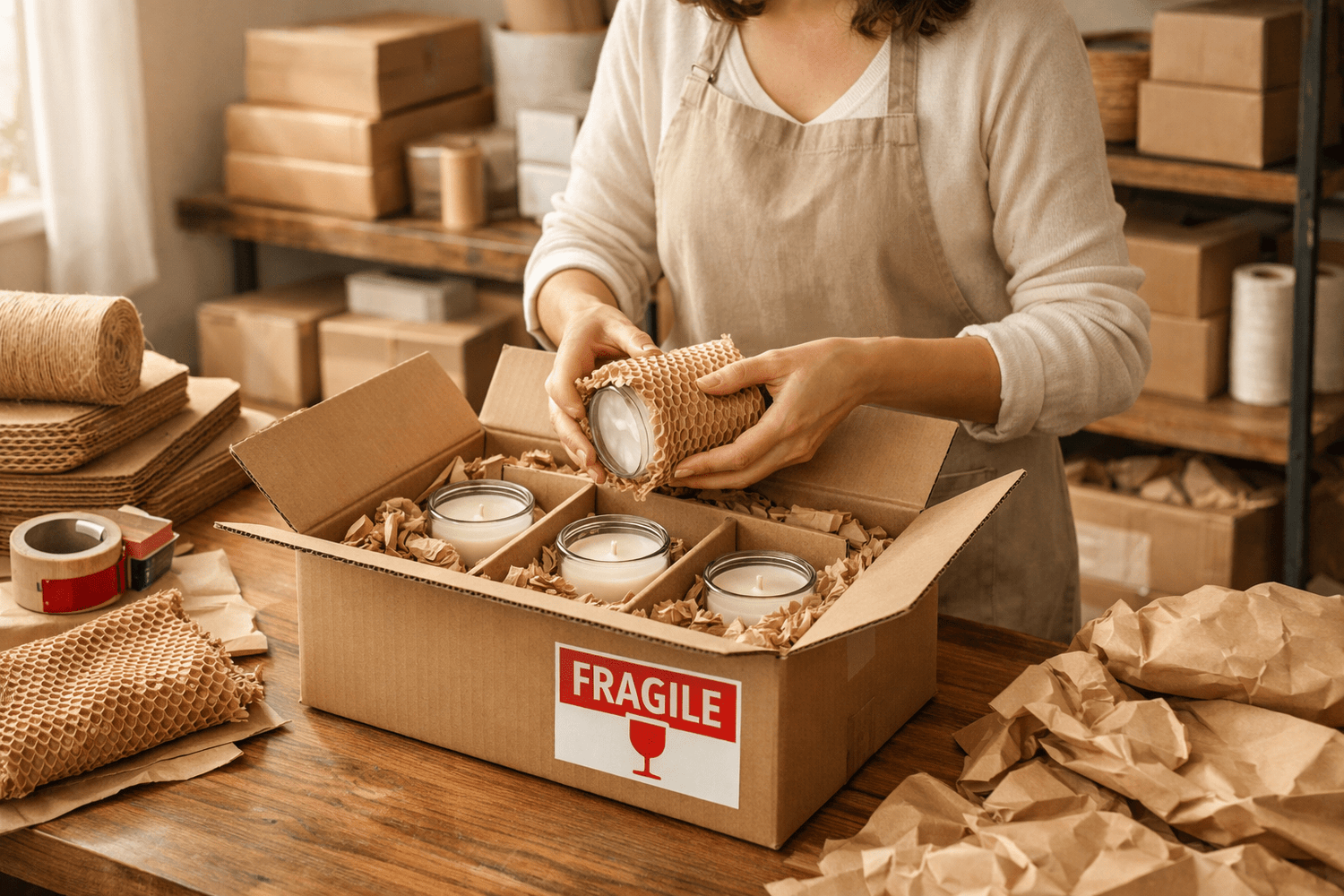

Shipping fragile items doesn’t have to feel like a gamble. Whether you’re sending glassware across the country or fulfilling online candle orders every day, knowing how to package fragile items for shipping properly can dramatically reduce breakages, returns, and unhappy customers.
In this practical, step-by-step guide, you’ll learn:
- How to package fragile items correctly
- The best materials for shipping fragile items
- “Fragile packing recipes” by product type
- A real-world story of how PackQueen helped an Australian candle brand reduce breakages and save thousands
- FAQs about packing fragile items
If you run an eCommerce brand, this guide could directly improve your bottom line.
Key Takeaways:
- Learn how to package fragile items for shipping with a step-by-step approach that reduces breakages and protects your products in transit.
- Discover the best materials for shipping fragile items, including boxes, void fill, and protective wraps for different product types.
- Understand practical techniques for packing fragile items efficiently to lower returns, improve customer experience, and protect your brand.
Why Proper Packaging for Fragile Items Matters
When packing fragile items, you’re protecting:
- Your product
- Your profit margins
- Your brand reputation
- Your customer experience
Breakages don’t just cost you a product. They mean:
- Replacement shipping costs
- Refunds
- Damaged reviews
- Lost repeat customers
Investing in premium Australian-made cardboard boxes and protective packaging isn’t an expense. It’s insurance.
For a broader overview of shipping best practices, explore our shipping and fulfilment packaging guide to understand how box selection, materials, and packing methods work together.
Step-by-Step: How to Package Fragile Items for Shipping
Step 1: Choose the Right Box
The box is your first line of defence.
When shipping fragile items, always use:
- A new, double-walled cardboard box for heavier items
- A snug-fit box (avoid excessive empty space)
- High-quality corrugated cardboard box
At PackQueen, our premium Australian-made cardboard boxes are engineered for strength and consistency. Choosing the right size from our range of mailing boxes, shipping cartons, and custom boxes ensures structural integrity during transit.
Box Selection Quick Guide
| Item Weight | Recommended Box Type | Wall Strength |
|---|---|---|
| Under 2kg | Single-wall carton | Standard corrugated |
| 2kg–10kg | Double-wall carton | Heavy-duty corrugated |
| 10kg+ | Reinforced carton | Extra heavy-duty |
Never reuse weakened boxes for fragile shipments.
Step 2: Wrap Each Item Individually
Every fragile item must be wrapped separately.
Use:
- Bubble wrap (minimum 2–3 layers)
- Honeycomb paper wrap
- Tissue paper (for scratch protection)
For glass and ceramics:
- Wrap in tissue paper first (prevents surface scratches)
- Add 2–3 layers of bubble wrap
- Secure with tape (but don’t tape directly to the product)
Step 3: Cushion the Base of the Box
Before placing your item inside:
- Add 5–8cm of void fill at the bottom
- Use biodegradable packing peanuts, kraft paper, or protective air pillows
This creates a shock-absorbing foundation.
Step 4: Eliminate Movement (The Golden Rule)
Movement = breakage.
Once your wrapped item is in the box:
- Fill all empty spaces
- Ensure the item cannot shift in any direction
- Shake the box gently — nothing should move
Recommended void fill options:
| Void Fill Type | Best For | Eco-Friendly Option |
|---|---|---|
| Kraft paper | Medium-weight items | Yes |
| Packing peanuts | Lightweight fragile items | Biodegradable versions available |
| Air pillows | Lightweight shipments | Limited |
| Cardboard inserts | Structured protection | Yes |
PackQueen offers custom inserts and internal fitments for brands wanting elevated protection and presentation.
Step 5: Seal Securely
Use high-quality packing tape.
Apply the H-taping method:
- One strip along the centre seam
- Two strips across the edges
This reinforces pressure points during shipping.
Step 6: Label Clearly
Always label:
- “FRAGILE”
- “THIS WAY UP” (if orientation matters)
While carriers don’t guarantee special handling, clear labelling increases care during sorting.
Fragile Packing Recipes by Product Type
Here are practical packaging formulas for common fragile products.
Glassware (Wine Glasses, Vases)
Materials Needed:
- Tissue paper
- 3 layers bubble wrap
- Double-wall box
- Kraft void fill
- Cardboard dividers (recommended)
Packing Recipe:
- Stuff the inside of the glass with paper
- Wrap in tissue
- Add 3 layers of bubble wrap
- Use dividers if shipping multiple items
- Fill all voids tightly
Ceramics (Plates, Mugs, Bowls)
Materials Needed:
- Honeycomb wrap
- Bubble wrap
- Double-wall box
- Cardboard inserts
Packing Recipe:
- Wrap each piece individually
- Separate with cardboard sheets
- Fill gaps with kraft paper
Candles (Jar Candles & Container Candles)
Candles present unique challenges: glass breakage, wax cracking, and lid displacement.
Materials Needed:
- Custom-fit cardboard box
- Internal cardboard insert
- Honeycomb wrap
- Paper void fill
Packing Recipe:
- Secure lid (add tissue layer between lid and wax)
- Wrap jar in honeycomb paper
- Place into snug-fit insert
- Fill remaining space with kraft paper
Custom inserts dramatically reduce internal movement — especially important for candle brands shipping daily.
Real Story: How PackQueen Helped an Australian Candle Brand Reduce Breakages
One Melbourne-based candle business approached PackQueen after experiencing a a significant breakage rate during peak season.
Their original setup:
- Generic single-wall boxes
- Minimal void fill
- No internal inserts
- Reused cartons
The result? Damaged glass jars, cracked wax, and rising refund costs.
Our Solution
We worked closely with their team to redesign their shipping system:
- Switched to premium Australian-made double-wall cartons
- Designed custom internal cardboard inserts to hold each candle securely
- Introduced honeycomb wrap instead of loose bubble wrap
- Standardised box sizes to eliminate excess void space
The Results
| Metric | Before PackQueen | After Implementation |
|---|---|---|
| Breakage Rate | High | Significantly Reduced |
| Monthly Replacement Costs | High | Reduced |
| Customer Complaints | Frequent | Minimal |
| Brand Perception | Inconsistent | Premium & reliable |
By upgrading to stronger, purpose-built candle packaging, they significantly reduced breakages — saving thousands in product loss and shipping costs.
More importantly, their customer reviews improved.
That’s the power of proper fragile packaging.
Recommended Materials for Shipping Fragile Items
If you regularly ship fragile goods, consider investing in:
- Premium corrugated cardboard boxes
- Custom box inserts
- Honeycomb paper wrap
- Kraft paper void fill
- Reinforced packing tape
- Custom printed boxes for brand impact
PackQueen offers a wide range of protective packaging solutions designed for eCommerce, retail, and wholesale shipping needs.
How to Test Your Packaging (Before Shipping at Scale)
Before sending 1,000 orders:
- Perform a shake test
- Conduct a 1-metre drop test (on multiple sides)
- Simulate stacking pressure
- Ship a test box to yourself
Packaging testing prevents expensive surprises.
Final Thoughts: Packaging Is a Profit Strategy
Knowing how to package fragile items correctly isn’t just operational — it’s strategic.
Better packaging means:
- Fewer returns
- Lower costs
- Stronger brand perception
- Happier customers
When shipping fragile items, your packaging should work as hard as you do.
Premium Australian-made cardboard solutions and structured void fill systems can dramatically reduce breakages — as our candle customer proved.
If you’re packing fragile items daily, it may be time to upgrade your packaging system.
Frequently Asked Questions (FAQ)
What is the best way to package fragile items for shipping?
Use a sturdy, properly sized box, wrap each item individually, eliminate all movement with void fill, and seal securely using the H-taping method.
What materials are best for shipping fragile items?
Double-wall corrugated boxes, honeycomb wrap, bubble wrap, kraft paper void fill, and custom inserts provide the best protection.
How do I ship glass items without breaking them?
Wrap in tissue and bubble wrap, stuff hollow sections, use dividers, eliminate movement, and choose a heavy-duty box.
Should I label a box as fragile?
Yes. While it doesn’t guarantee special handling, it increases awareness during sorting and transit.
How can I reduce breakages in my eCommerce business?
- Upgrade to stronger cardboard boxes
- Use custom inserts
- Remove empty space inside cartons
- Conduct drop tests
- Standardise packaging processes