By Monique, Founder of PackQueen · Packaging Strategy · 8 min read
3 Things You'll Take Away From This Article
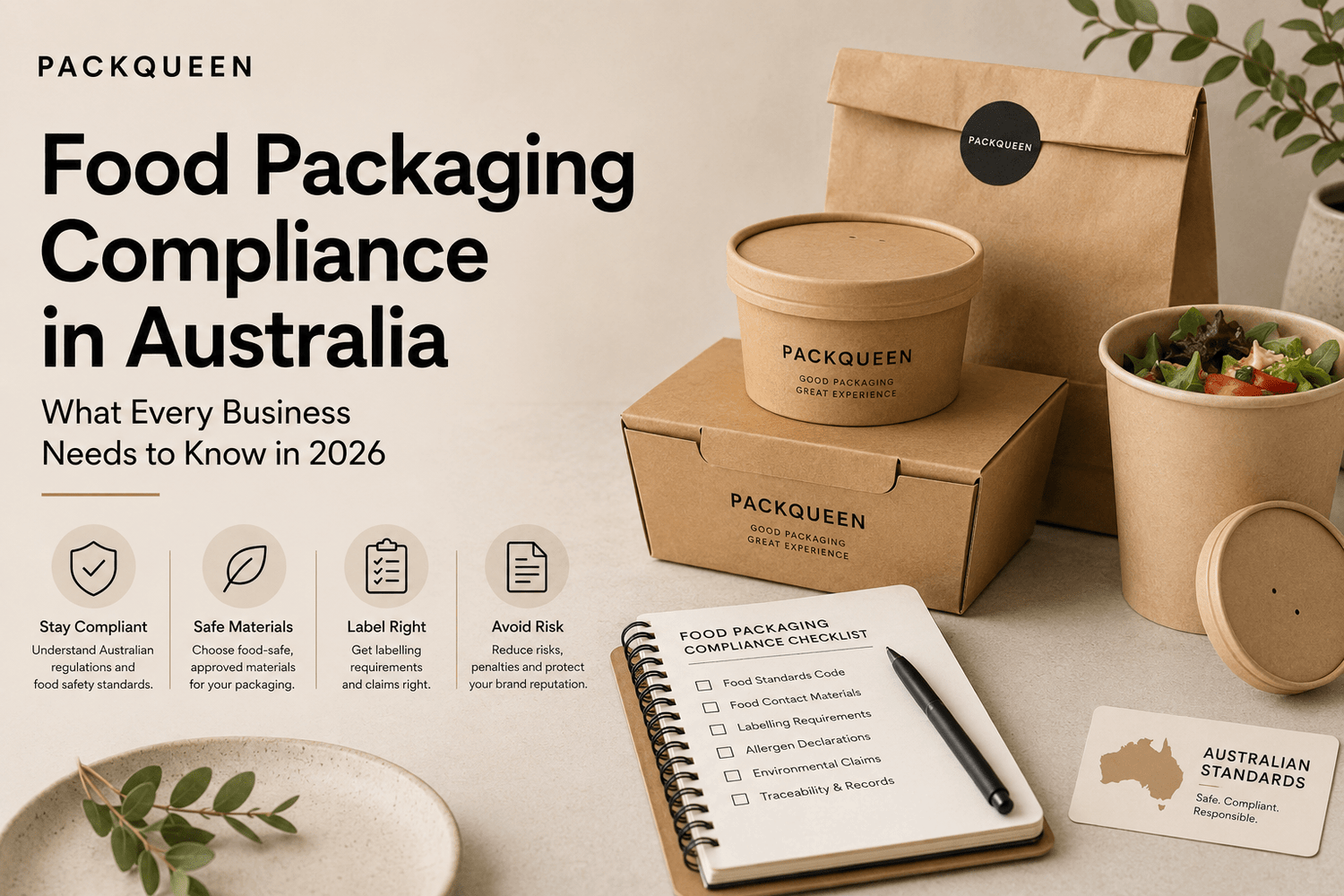
➡ Food packaging compliance in Australia is more complex than most businesses realise. Between FSANZ requirements, state-level regulations, labelling rules and sustainability obligations, the compliance landscape has layers — and gaps are costly.
➡ Non-compliant food packaging can shut down a business. Recalls, fines and prohibited sales are real consequences for Australian food businesses that get packaging wrong.
➡ Compliance and great brand packaging aren't mutually exclusive. The best food packaging solutions meet every regulatory requirement while still delivering a premium brand experience.
⚠️ This article provides general guidance. It does not constitute legal or regulatory advice. For your specific products, always consult with a food safety consultant, FSANZ resources, or your relevant state food authority.
Why Food Packaging Compliance Matters More Than Ever in 2026
Hi, I'm Monique — founder of PackQueen. If you're selling food products in Australia — whether that's direct to consumers, through retailers, at markets, or via subscription — your packaging is a regulated document. It's not just a box or a bag. It's a legal communication with your customers, and getting it wrong has consequences.
In 2026, the stakes are higher than ever. The ACCC and state food safety authorities are actively auditing, consumer expectations around allergen labelling have intensified, and sustainability-related packaging regulations are adding new requirements to the mix.
The Key Regulatory Bodies You Need to Know
| Body | Role | What They Cover |
|---|---|---|
| FSANZ | Food Standards Australia New Zealand | Sets food labelling standards (Food Standards Code) |
| ACCC | Australian Competition & Consumer Commission | Enforces consumer law incl. misleading claims |
| State/Territory Food Authorities | NSW Food Authority, SAFSA, etc. | Local enforcement, food business registration |
| APCO | Australian Packaging Covenant Organisation | Packaging sustainability obligations |
| TGA | Therapeutic Goods Administration | For food products making health claims |
Food Labelling Requirements Under the Food Standards Code
The Australia New Zealand Food Standards Code sets out mandatory labelling requirements for most packaged food sold in Australia.
Mandatory label elements
- Product name — the name of the food, which must not be misleading
- Ingredient list — listed in descending order by ingoing weight, with all additives disclosed
- Allergen declarations — the 9 major allergens must be clearly declared in bold or otherwise emphasised text
- Nutrition information panel (NIP) — mandatory for most packaged foods, with prescribed format
- Date marking — 'Best before' or 'Use by' depending on the product and shelf life
- Country of origin — mandatory under the Country of Origin Labelling standard, with specific text and/or graphic requirements
- Net weight / volume — in metric units, with prescribed size requirements based on label area
- Business name and address — the name and Australian address of the responsible business
- Storage conditions — required where product safety depends on correct storage
- Directions for use — required where product won't be safe or suitable without them
The 9 Mandatory Allergens
| Allergen | Declaration Requirement | Common Packaging Pitfall |
|---|---|---|
| Peanuts | Bold or emphasised in ingredient list | Missing from shared-equipment declarations |
| Tree nuts | All varieties must be specified | 'May contain nuts' not sufficient alone |
| Milk | Includes all dairy derivatives | Casein, whey not always identified |
| Eggs | Includes all egg derivatives | Lecithin (E322) source not declared |
| Wheat / gluten | All gluten-containing grains | 'Gluten-free' claims without testing |
| Soy | All soy derivatives | Soy lecithin often missed |
| Fish | Species must be named | Generic 'fish' not acceptable |
| Shellfish & crustaceans | Must distinguish between types | Grouped as 'seafood' — not compliant |
| Sesame seeds | Added to mandatory list 2024 | Frequently missing from older labels |
Country of Origin Labelling: What It Means for Your Packaging
- 'Made in Australia' — requires that the product is substantially transformed in Australia AND the significant ingredients are Australian. This is a high bar.
- 'Product of Australia' — the highest standard: all significant ingredients AND processing must be Australian.
- Bar chart graphic — required for most packaged foods. Shows the percentage of Australian ingredients. Must appear in the correct format.
- 'Packed in Australia' — requires disclosure of the country of origin of the major ingredients.
💡 The bar chart must be a specific size relative to your label area. Check the ACCC's Country of Origin Food Labelling guidelines for your specific label dimensions before printing.
Packaging Materials: What's Permitted in Contact With Food
| Material | Food Contact Status | Notes |
|---|---|---|
| Food-grade cardboard | ✅ Approved | Must be food-grade specification — not standard print cardboard |
| Food-grade kraft paper | ✅ Approved | Widely used for wrapping, lining, bags |
| Standard printed cardboard | ⚠️ Not for direct contact | Inks and coatings may not be food-safe |
| PLA bioplastic | ✅ Generally approved | Check specific food-contact certification from supplier |
| Recycled cardboard/paper | ⚠️ Check certification | Must be tested and certified for food contact |
| Aluminium foil | ✅ Approved | Food-safe when food-grade specification |
| Standard bubble wrap | ❌ Not for direct food contact | Not food-safe — use food-grade alternatives |
| Compostable bags (PLA/PBAT) | ✅ Generally approved | Verify food-contact certification from supplier |
Real example → A gourmet condiment brand wanted to transition to 'sustainable' packaging — specifically recycled cardboard boxes. We had to advise them that their products needed food-grade inner lining because the jars were unsealed display products. Getting this right before their retailer launch saved them a potentially costly recall.
Explore our range of food packaging — all food-safe options available.

Frequently Asked Questions
1. Do I need a Nutrition Information Panel on all food products?
Almost. The FSANZ Food Standards Code requires a Nutrition Information Panel (NIP) on most packaged foods, with specific exemptions:
- Exempted: Foods sold only at the point of manufacture, individual portions weighing under 100g, and some raw single-ingredient foods
- Not exempted: Any packaged food sold through retail channels, at markets where food is not made on-site, or online
- Health claims add requirements: If you make any nutrition or health claim, a NIP is mandatory regardless of other exemptions
When in doubt, include the NIP. The cost of adding it to your label design is trivial compared to the cost of a non-compliant product being pulled from shelves.
2. What are the rules around 'natural', 'organic' and 'free-range' claims?
| Claim | What's Required | Risk if Unsubstantiated |
|---|---|---|
| Organic | Certification from ACO, NASAA or equivalent | ACCC action, consumer complaints, retailer de-listing |
| Natural | No legal definition — must not be misleading | ACCC action if used to imply no artificial ingredients when present |
| Free-range (eggs) | Must meet ACCC Free Range Egg Labelling standard | Significant fines — this area is actively enforced |
| Gluten-free | Must be tested; <3ppm gluten threshold | Recall risk, regulatory action, serious safety implications |
| Low fat / reduced fat | Specific compositional thresholds apply | ACCC action for non-compliant claims |
3. Can I use the same packaging for retail and farmers' market sales?
Yes — and it's often the most practical approach. Designing your packaging to meet retail compliance requirements means it's automatically suitable for market sales. The reverse is not true: market packaging frequently lacks elements required for retail.
- Retail-compliant labels include all 10 mandatory elements
- Markets may not require a NIP for small producers selling direct — but including it doesn't hurt
- Online sales must meet full retail labelling requirements in most categories
If you have any intention of moving into retail — design your labels to the full retail compliance standard from the beginning. Redesigning packaging mid-growth is expensive and disruptive.
4. How do I stay up to date with changing food packaging regulations?
- FSANZ website (fsanz.gov.au) — subscribe to their food standards updates newsletter
- ACCC Greenwashing guidance — updated regularly; important for any environmental claims on your packaging
- APCO member updates — covers packaging sustainability regulation changes
- Industry associations — AFGC, Fine Food Australia and state food industry associations often communicate regulatory changes to members
- Your food labelling consultant — for a product-specific compliance review, an annual consultation is a worthwhile investment
Get in touch if you have questions about food-safe packaging options from the PackQueen team.
Monique | Founder, PackQueen
packqueen.com.au · Food Packaging Solutions for Australian Businesses